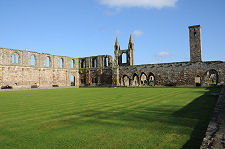
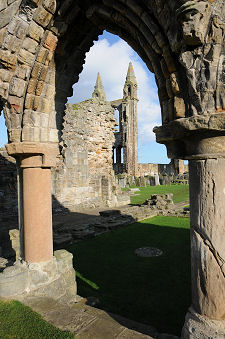
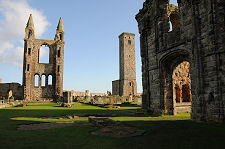
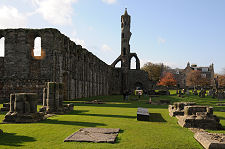
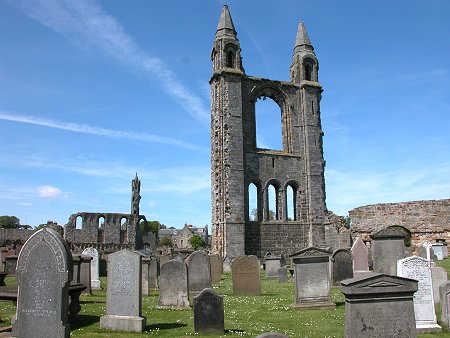
 St Andrew's Cathedral from the East |
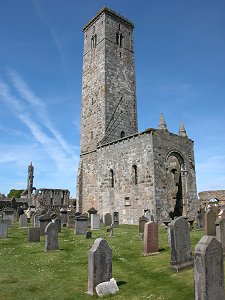
Sitting at the eastern end of St Andrews' two main streets is the imposing, if slightly confusing, collection of ruins that together make up St Andrews Cathedral and a number of associated religious buildings including St Rule's Tower, just to the south-east of the cathedral, and St Mary's Church, just outside the precinct wall.
A religious community was probably first located on this site in about 732, when relics of St Andrew were brought to what was then known as Kilrimont or Cennrígmonaid by Bishop Acca of Hexam. There is an alternative and probably more fanciful story, that Saint Rule (also known as St Regulus) brought a number of St Andrew's bones here by boat in 347, having sailed from from Patras in Greece and eventually surviving a shipwreck near the site of today's harbour.
Either way, the settlement that became St Andrews rose through the dark ages to an eminent position in the Scottish church, a process that was accelerated when Viking raids led to the removal from Iona of St Columba's relics in 849AD, and with them much of Iona's power base.
By 1144 St Andrews' place in the Scottish Church was confirmed with the setting up here of a community of Augustinian Canons. At the same time, an existing band of clergy, the Culdees, were displaced, eventually finding a permanent home in the most easterly of the three churches on the rocky promontory occupied by the cathedral. This, the church of St Mary on the Rock, is now barely visible above ground level on a site overlooking the harbour outside the precinct wall of the cathedral.
The Augustinians took as their own St Rule's Church, which dates from about 1123, but which was extended in 1144 to accommodate them. Today, all that remains of St Rule's Church is a small part of the chancel and an implausibly high tower. This is accessible to visitors and, at 100ft high, provides superb views over St Andrews and the surrounding area.
By 1160 it was clear that St Rule's Church was too small to accommodate the ambitions of the Bishops, and work began on what was to become the largest cathedral ever to be built in Scotland. The work took nearly 150 years to complete. It was eventually consecrated on 5 July 1318 in the presence of Robert the Bruce.
The cathedral was not blessed by favourable elements or good luck, either during its construction or after its completion. Shortly after the nave was finished, the west end of the cathedral was blown down in a gale in 1270. This was rebuilt in a slightly different position, where parts of it remain today. Then the English stripped the lead from the part-built roofs during the Wars of Independence. In 1378 the cathedral was badly damaged by fire and had to be extensively rebuilt. And in 1409 it was the turn of the end of the south transept to collapse under the force of a winter storm.
Amongst notable Ecclesiastics associated with the cathedral in the middle ages was Bishop James Kennedy, who also founded St Salvator's College at the University of St Andrews.
The wind of change wrought by the Reformation brought about the end of the cathedral. On 11 June 1559 John Knox preached a sermon in St Andrews parish church that so aroused the congregation they immediately went to the cathedral and destroyed the splendid fittings and furnishings associated by the reformers with "popery" (see our Historical Timeline). The end followed quickly. The Church of St Mary on the Rock was probably completely destroyed shortly after it was first attacked. The cathedral and its friary effectively ceased to function on 14 June 1559 when further attacks took place, and within a week all the friars has been "violently expelled" from St Andrews.
Over the following decades there continued to be debate about restoring this, the greatest of Scottish cathedrals, but by the late 1600s the cathedral's main role was as a quarry providing much of the building material for the subsequent development of St Andrews.
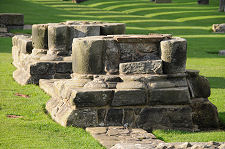
Today, what remains is rather fragmentary. A fair part of the magnificent precinct wall surrounding the cathedral can still be seen. Within it, you will find a portion of the west end of the cathedral, facing St Andrews, plus one nave wall, looking rather bleak, and the east gable.
To the south of the main cathedral, visitors can still wander around part of the cloister or examine the graves unearthed under the floor of the chapter house. There is also an excellent visitor centre in the undercroft of the refectory, on the south side of the cloister. This gives access to the superb St Andrews Cathedral Museum, which has an outstanding collection of carved stonework on view dating from the Pictish era until after the Reformation.
Much of the remainder of the precinct is now given over to the graveyard, and for those who find fascination in wandering around such places, this is an especially interesting one: though the best and oldest gravestones are now protected from the elements in the museum. Of particular interest given St Andrews' golfing connections is the grave of Young Tom Morris, the golfer.
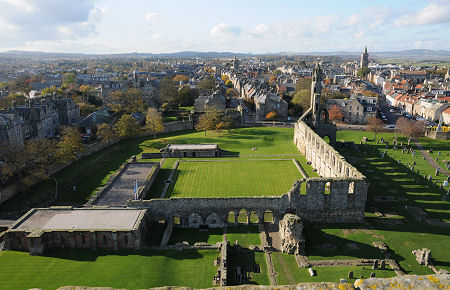 The Cathedral from the Top of St Rule's Tower |
|
|
|
Visitor InformationView Location on Map4 Star Historic Attraction. Tel: 01334 472563. Post Code: KY16 9QL Grid Ref: NO 513 166 www.historicenvironment.scot HES: Cathedral Web Page Opening Hours Admission Accessibility What3Words Location: ///intruding.model.calm |
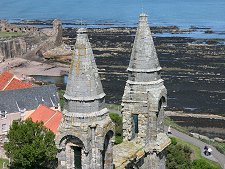 Top of the East Gable |
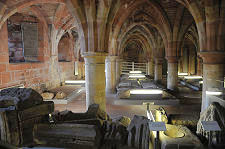 Museum: The Undercroft |
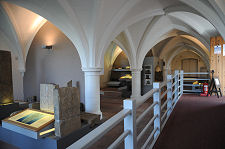 Museum: The East Range |
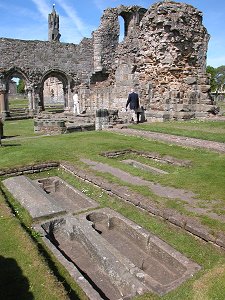 Chapter House Graves |
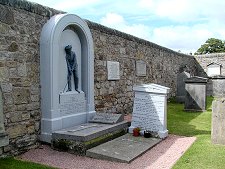 Tommy Morris's Grave |
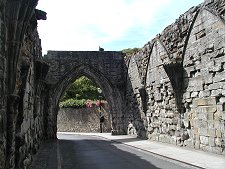 The Pends Gate |