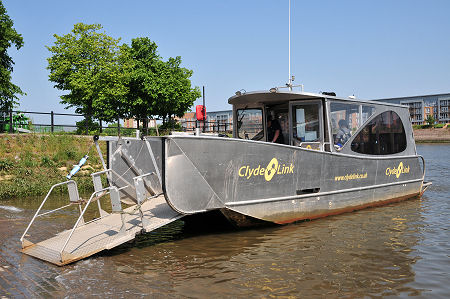
 The Clyde Link Ferry at Renfrew |
The Renfrew to Yoker ferry ceased operations on 31 May 2025, following the opening earlier that month of the new Renfrew Bridge over the River Clyde half a mile downstream. This made the ferry the last of eleven that once crossed the Clyde to close. This page will remain, but is now of historical interest only.
The Renfrew to Yoker ferry provides a passenger-only ferry service across the 200m wide River Clyde between Renfrew on the south bank and Yoker on the north bank.
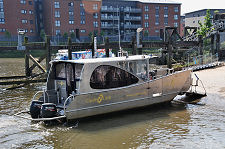
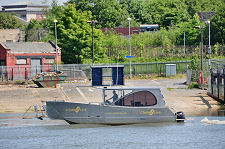
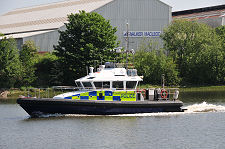
Since April 2010 the service has been operated by Clyde Link. The ferry currently in use appears to be nameless, which is unusual for a boat. We also show on this page the ferry initially used by Clyde Link, the Island Trader, an aluminium landing craft built by Robust Boats of Haverfordwest in Wales.
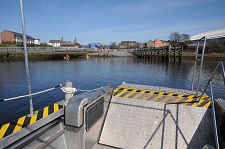
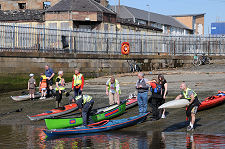
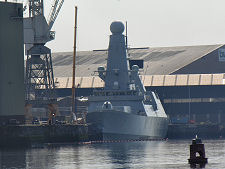
On a fine day you can enjoy the views along the Clyde, which includes one of the Clyde's surviving shipyards as well as new housing developments where other shipyards once stood. Passengers board via a front ramp from concrete slipways originally built to support car ferry services. (Continues below image...)
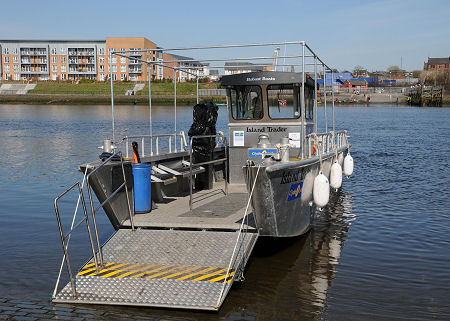 Island Trader at Renfrew |
There are a couple of things passengers should bear in mind. Firstly, depending on the time of day the service is either "on demand" or half hourly. See the website linked from this page for more information. Should any crossing be full additional runs are made until all waiting passengers are ferried across the river.
Ferries have been crossing the Clyde for millennia. Opinions differ about the history of this particular route. By some accounts there was a ferry operating between Renfrew and Clydebank, on the north bank a little downstream, as early as 1614. Another source suggests that a crossing a little upstream, between what is now Scotstoun and what is now the Braehead Retail Park, operated even earlier. Perhaps both of these early ferries existed.
The route in use today dates back at least 200 years, providing the shortest crossing serving Renfrew, which was becoming increasingly important at the time. Many other ferries also crossed the Clyde: as recently as the 1960s there were still ferries operating at Erskine, Whiteinch, Partick, Govan and Finnieston. The earliest ferries were little more than rowing boats. Later ferries were pulled across by hand using ropes or chains.
By the 1930s the boom in motor traffic had led to the introduction of a vehicle ferry between Renfrew and Yoker. In 1952 a new larger roll-on roll-off ferry was introduced. The Renfrew was a diesel electric ferry which hauled itself across the river using a submerged chain. She became more commonly known to her users as HMS Back & Furrit.
By the end of the 1970s the need for ferries across the Clyde had declined with the arrival of fixed links such as the Erskine and Kingston Bridges and the Clyde Tunnel. Most of the ferry services simply ceased. At Renfrew there remained a need to transport shipyard workers and others across the river, and because of the clearance that would be needed by river traffic, a bridge was not a practical alternative. The decision was therefore taken to replace the Renfrew with the two purpose built passenger ferries, Renfrew Rose and the Yoker Swan. Both were built by McCrindle Shipbuilding Ltd of Ardrossan in 1984. The Renfrew has gone on to a career as a "multi-purpose entertainment venue" and is now moored at Anderston Quay in the centre of Glasgow. Rather more recently, the Renfrew Rose, after a period in Ireland, has commenced operations as the Cromarty to Nigg Ferry.
By 2007 each of the 150,000 passenger journeys made each year was costing twice as much in subsidy as it earned in fares and a replacement bridge was mooted, but the cost turned out to be prohibitive. In early 2010 it was announced that the subsidy would be removed from the existing service and for a while it seemed that operations would cease altogether. The arrival of Clyde Link should ensure that there will be a ferry service across the Clyde for some time to come.
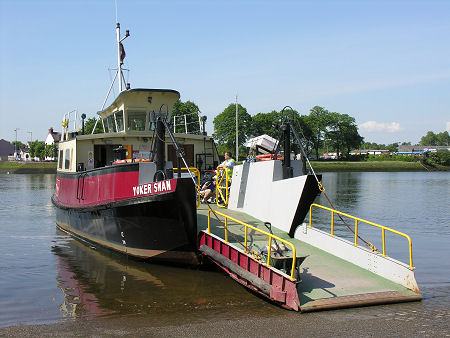 The (Now Replaced) Yoker Swan at Yoker |
|
|
|
Visitor InformationView Location on MapWhat3Words Location: ///join.giant.dared |
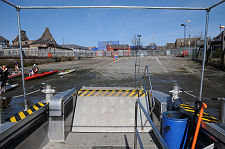 Arriving at Yoker |
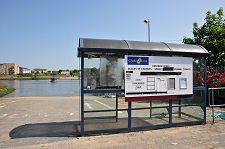 Shelter |
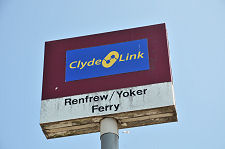 Sign |
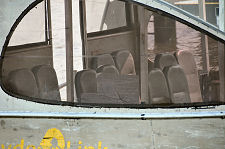 Passenger Cabin |
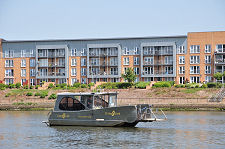 Turning in the Clyde |
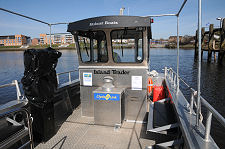 On Board Island Trader |
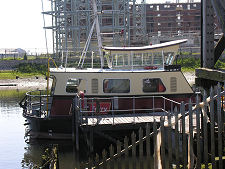 The (Now Replaced) Renfrew Rose |