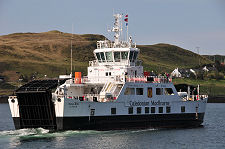
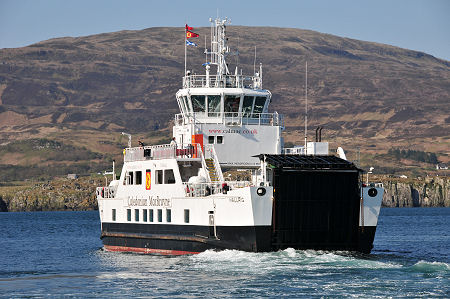
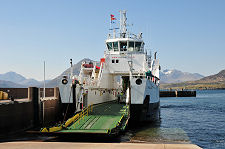
 MV Hallaig Leaving Churchton Bay on Raasay |
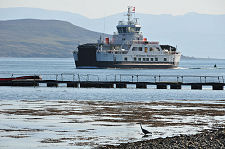
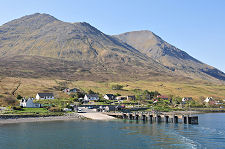
You know you are getting well off the beaten track in Scotland when you find yourself on an island that can only be reached from another island. The island of Raasay, some 14 miles long and a maximum of a little over 3 miles wide, lies off the east coast of the Isle of Skye. The ferry serving the island leaves from Sconser, near the mouth of Loch Sligachan on the Isle of Skye, before crossing the southern end of the Sound of Raasay to a terminus at Churchton Bay, near Raasay House, on the south-western shore of Raasay.
The terminus at Churchton Bay is a relatively recent development, the product of a major construction project which was opened to the public in August 2010. Until then the ferry had used a slipway further down the coast at Suisnish, a pier which had originally been built to export iron ore from a now long-disused mine on Raasay and which by 2008 was in an advanced state of decay. Even when it had been in good repair the pier at Suisnish did not offer effective overnight shelter for the ferry, which was a problem as the ferry is based on Raasay. The hillside above the pier still has built into it a vast concrete hopper used to hold the iron ore prior to its being shipped out. On our last visit, Suisnish was almost lost beneath stacks of freshly cut timber, a result of large scale forestry operations across parts of the island.
A rather less ambitious project to upgrade the facilities at the Skye end of the service resulted in the opening of a new slipway and waiting room at Sconser in August 2013. In this case the motivation was the need to accommodate a new ferry on the route. (Continues below image...)
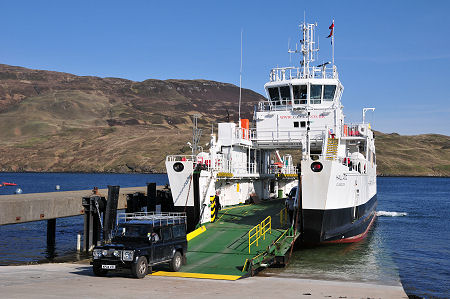 MV Hallaig Unloading at Sconser |
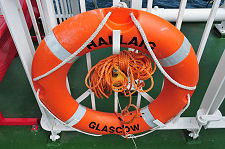
The ferry used on the Skye-Raasay service is the MV Hallaig. She was built at Fergusons Shipbuilders in Port Glasgow on the River Clyde and launched in December 2012. She took over the service on 17 October 2013. She was the first commercial (as opposed to naval) ship to be entirely built on the Clyde in over five years. MV Hallaig is named after a disused township on the south-eastern side of Raasay, which in turn came to notice because its name was used as the title of a poem by renowned Gaelic poet, and native of Raasay, Sorley MacLean.
MV Hallaig marks a major step forward in ferry design, using a hybrid system that combines diesel electric power with lithium ion batteries. The banks of batteries are charged overnight and designed to provide a minimum of 20% of the total power consumed by the ship. She cost significantly more to build than a conventional ferry, but on the other hand is significantly cheaper to run, quieter, and creates a much lower level of emissions than a conventional ferry.
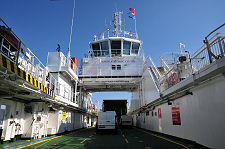
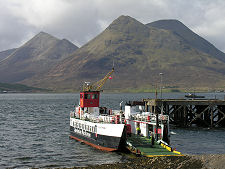
From a passenger's point of view the differences are not immediately obvious. What is more obvious is that the introduction of MV Hallaig to the route marked a significant increase in capacity. She can carry 23 cars (or two large HGVs) and up to 150 passengers. The ferry she displaced on the route, MV Loch Striven, could carry more passengers (203), but only 12 cars. As Raasay had a population of just 161 in 2011 (down from 194 a decade earlier) the increase in car-carrying capacity is much more important than the decrease in passenger-carrying capacity.
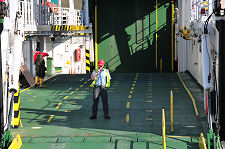
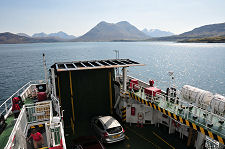
MV Loch Striven had operated the route since 1999. At that time she had herself doubled the six car carrying capacity of her predecessor, MV Raasay. The 1999 arrival of the MV Loch Striven on the route also meant it was no longer necessary for drivers to reverse their vehicles onto the ferry. Where it still takes place this is always an enjoyable spectator sport, but it does little for the smooth or speedy loading of ferries. It goes without saying that MV Hallaig is double-ended, and you simply drive on, and then off at the other end.
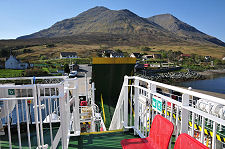
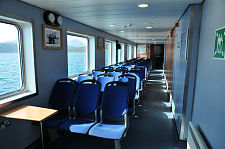
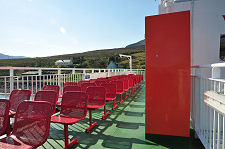
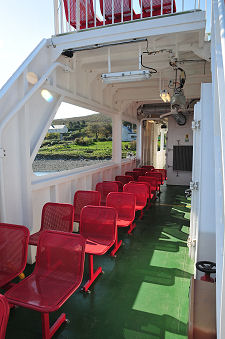
Passenger accommodation on board MV Hallaig is located along one side of the vehicle deck. A comfortable passenger lounge at car deck level runs for much of the length of the vessel and provides shelter in poor weather. Above this is an intermediate level offering seating that has overhead protection, while the upper deck provides outdoor seating, which is ideal for the sort of day on which the images on this page were taken. As the crossing takes around 25 minutes, many passengers prefer to remain in their vehicles. The service operates seven days per week, with around nine sailings each way six days per week, and two each way on a Sunday. For current timetable and fare information, and for bookings, visit CalMac's website.
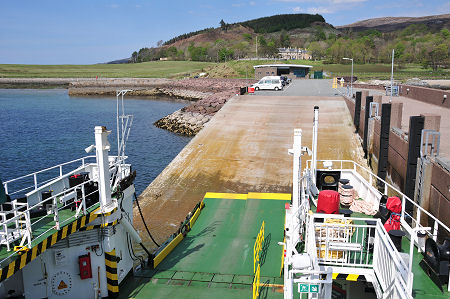 Churchton Bay Terminus and Distant Raasay House from MV Hallaig |
|
|
|
Visitor InformationView Location on MapFull details, including current timetables and prices can be found on CalMac's website. |
 Arriving at Churchton Bay |
 Heading for Skye |
 On Board MV Hallaig |
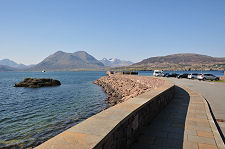 The Pier at Churchton Bay |
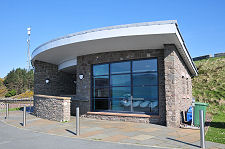 Waiting Room at Churchton Bay |
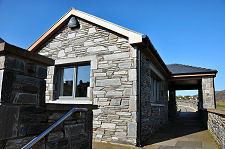 Waiting Room at Sconser |
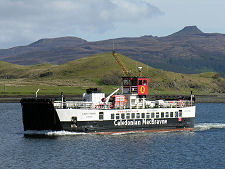 MV Loch Striven at Sconser in 2009 |
 MV Loch Striven at Suisnish in 2009 |
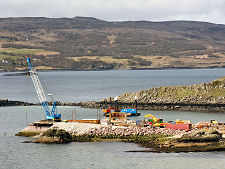 Churchton Bay Terminus Under Construction in 2009 |