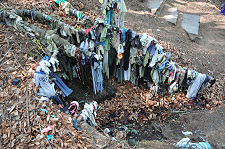
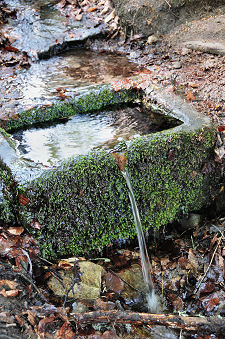
 The Well Outflow in 2019 |
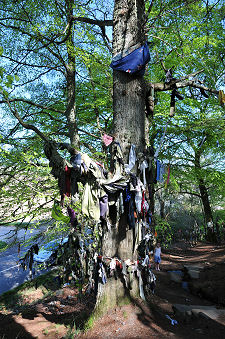
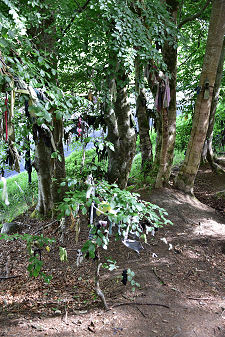
The village of Munlochy sits astride the B9161 close to its junction with the A832 in the heart of the Black Isle, the promontory that lies north of Inverness, bounded by the Moray Firth to the south and the Cromarty Firth to the north. Half a mile west of this junction, the A832 enters a forested area, and as it does, passing motorists used to be treated to the odd spectacle of bits of cloth and clothing hanging off the trees and bushes on the south side of the road.
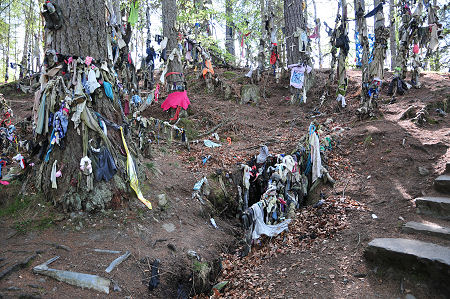
This was the Clootie Well, one of the strangest places in Scotland. Creepy, spooky and unsettling, even on a sunny day, the Clootie Well had an atmosphere that was far from pleasant: but deeply fascinating. The Clootie Well was a rather weird remnant of an ancient tradition once commonly found in Scotland and Ireland, of holy wells to which pilgrims would come and make offerings, usually in the hope of having an illness cured. (Continues below images...)
 The "Curated" Himalayan Prayer Flag Look in August 2025 |
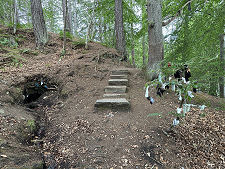
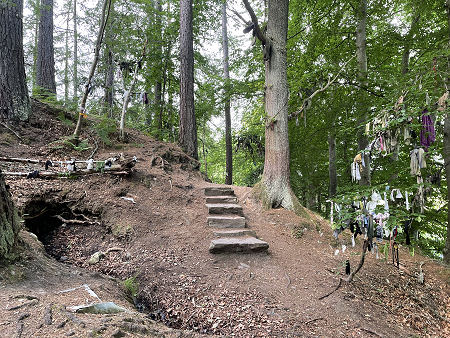 The Clootie Well Post-Clearance in June 2022 |
The holy well at Munlochy is said to date back to - and probably beyond - the time of St Boniface or St Curitan, who worked as a missionary in Scotland in about AD620. Pilgrims would come, perform a ceremony that involved circling the well sunwise three times before splashing some of its water on the ground and making a prayer. They would then tie a piece of cloth or "cloot" that had been in contact with the ill person to a nearby tree. As the cloot rotted away, the illness would depart the sick person.
The origins of the tradition are probably pagan, but became adapted with the coming of Christianity. Over time, most of these holy wells became associated with local churches. A good example was at St Mary's, the Parish Church of Tyninghame and Whitekirk, in East Lothian. In just one year, 1413, no fewer than 15,563 pilgrims visited the holy well at St Mary's, to the great financial benefit of both the church and local economy.
Over time, as the Roman Church supplanted the Celtic Church in Scotland, practices which echoed the old pagan ways became frowned upon, and the number of holy wells diminished. And the Reformation of 1560 also served to suppress religious activity outwith a closely defined Presbyterian norm: in 1581 an Act of Parliament in Scotland made pilgrimage to holy wells illegal. Nonetheless the practice seems to have continued in some areas, and when Welshman Thomas Pennant toured Scotland in 1769, he recorded seeing holy wells "tapestried about with rags".
The observant may have noticed our uses of the past tense in parts of this feature. The Scottish Daily Mail reported on 22 January 2022 that someone had cleared the Clootie Well of the offerings left by visitors, leaving very few traces of what what had been there before. A copy of the report can be seen here.
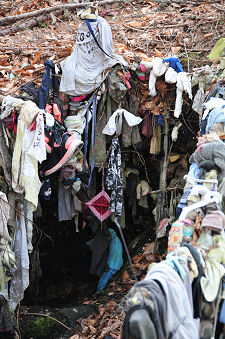
We'd visited in 2007 and 2019 and it seemed to us that the quantity of offerings had increased significantly between our visits. After our 2019 visit we commented on this page that this did little for the local environment: and neither, according to the tradition of the well, could it do anything for the health of the individual needing to be cured.
Despite our mixed feeling about the place, we found a revisit in June 2022 to be rather shocking. A few faded and tatty remnants were on view, but in effect the Clootie Well, and its 14 centuries-old tradition, had been erased from the landscape and from Scotland's heritage. The press article linked above said this had been done by a single individual, something since confirmed to us by someone who witnessed what happened. The sheer amount of stuff that was removed had left us wondering whether one person alone could possibly have shifted it all, but it seems they did.
We were subsequently told that offerings were building up again during the second half of 2022 and the first of 2023. If so, then a visit in June 2023 showed that the clean up squad/individual had been back, this time doing an even more thorough job. Photographs on this page are from our 2007 and 2019 visits: and from June 2022 and June 2023 showing the scale of the clearances. A further visit at the end of August 2025 showed a partial return of the offerings, but in a way that felt very "curated" with many of the offerings arranged on curved sticks in a way that was very reminiscent of Himalayan prayer flags. Meanwnile, the main set of stone steps up from the parking area had been given a rope handrail suspended from substantial wooden posts. Civilisation has, apparently, arrived.
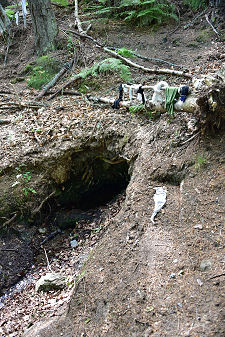
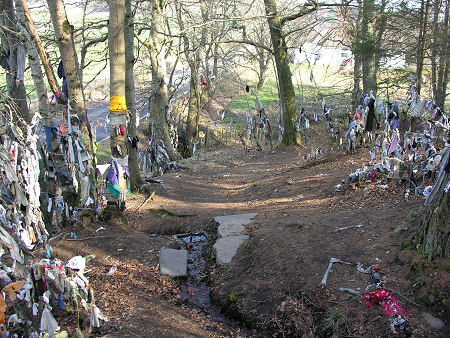 The Well from Higher Up the Hill in 2007 |
|
|
|
Visitor InformationView Location on MapGrid Ref: NH 641 537 What3Words Location: ///strong.giants.fictional |
Clootie Well In Fiction
|
 A Tangled Web by Ken Lussey (15 November 2023).
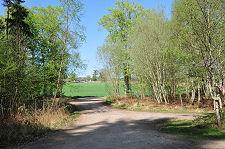 Car Park Entrance |
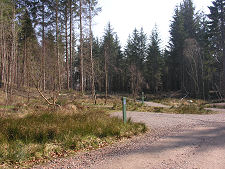 Parking |
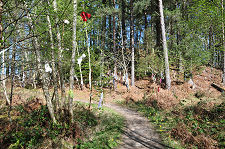 Start of Path |
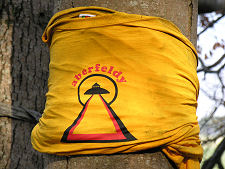 Take Me To Your Leader, 2007 |
 Official Guidance in August 2025 |
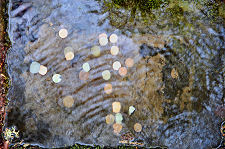 Offerings, 2019 |
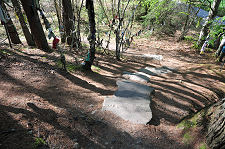 The Stone Steps As They Were |
 The Stone Steps in August 2025 |
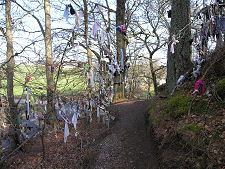 Path Leading to the Well, 2007 |