 Nether Largie South Cairn |
Kilmartin Glen is the name given to the broad valley extending south from the village of Kilmartin, itself found north of Lochgilphead and south of Oban. The Glen is famous for its rich archeological legacy and serves as the nearest that mainland Scotland has to offer to a theme park of ancient (and not so ancient) history. Within six miles of Kilmartin there are over eight hundred ancient monuments of a wide variety of types. They include burial cairns, rock carvings, and standing stones, as well as the remains of the fortress of the Scots at Dunadd and more recent castles.
The purpose of this page is to draw together individual features on Undiscovered Scotland about specific attractions in Kilmartin Glen. That inevitably means that we discuss only a very small proportion of what there is to see in the glen, but as our coverage increased over time, this page will become more comprehensive.
The focal point for any exploration of Kilmartin Glen has to be the Kilmartin Museum, which can be found in the village of Kilmartin. The museum stands on the west side of the main road passing through the village, immediately north of Kilmartin Church.
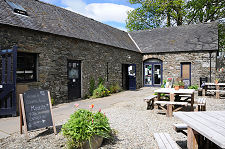
From the visitor's point of view, a trip round the museum provides essential background to the story of the area and is highly recommended. The ancient monuments so richly scattered across the glen are fascinating, but when you see them on the ground it is often very difficult to imagine what the people who built them must have been like. Kilmartin Museum does an excellent job filling in the otherwise missing human dimension and setting the monuments on the ground in their proper context. The museum also houses a welcoming reception area, a gift shop combined with an excellent bookshop, and a rather fine cafe.
You don't have to stray far from the museum to get to grips with the history. Immediately to its south is Kilmartin Parish Church. This was built in 1834-5, but is only the latest in a line of churches to have stood on the same site. Evidence of the long history of Christianity in the immediate area can be found in the form of two magnificent stone crosses (and part of a third) on display within the church. These originally stood in stone sockets still visible in the churchyard, but have been rehoused to preserve them from the elements.
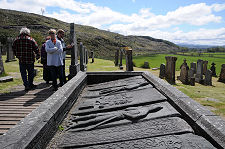
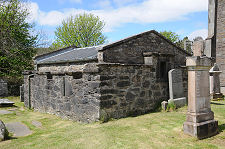
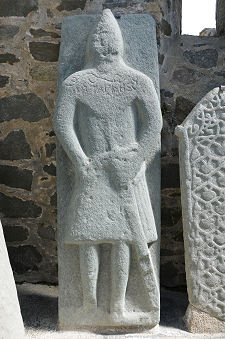
The churchyard is home to a wonderful collection of sculptured medieval graveslabs. 23 of the stones are on display in the lapidarium, originally a burial aisle, just to the south of the church. Not far away a further seven have been displayed in a stone enclosure, while others can be seen in situ on the ground in various parts of the churchyard.
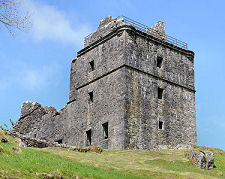
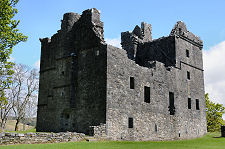
One of the (relatively) more recent historical attractions in the area is Carnasserie Castle, standing on a hillside above the main road just over a mile north of Kilmartin. The castle was built in the years between 1565 and 1572 for Bishop John Carswell, and apart from some changes to the windows in the south wall made in 1681, it remained virtually unaltered throughout an active life of a little over a century. The result is a remarkable example of the architecture of the day and an excellent place to visit.
The wonders of Kilmartin Glen are not all man-made. The Moine Mhor or Great Moss lies at the southern end of the glen and does a half-way decent job of turning the rest of the Kintyre peninsula into an island. It covers 1,200 acres and is one of very few estuarine raised bogs left in Europe. It became a National Nature Reserve in 1987.
On the east side of the Moine Mhor is a rocky outcrop 175 feet high, once the site of Dunadd. It may not look much today, but between AD500 and AD900 this was one of the most important places in what has since become Scotland. The original Scots were migrants from Ireland who from about 500 settled across Argyll in ever greater numbers, founding the Kingdom of Dalriada. Dunadd was the capital of the Kingdom and was the place where its Kings were anointed.
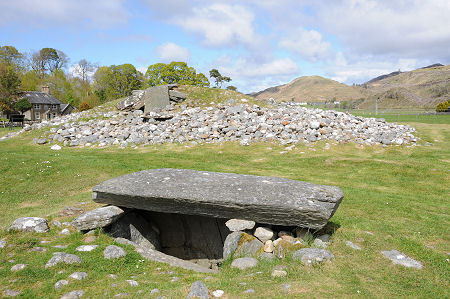
Among the very many prehistoric monuments in Kilmartin Glen, Temple Wood, with its twin stone circles, stands out as especially well worth a visit. Others that can be found nearby include Dunchraigaig Cairn, Ri Cruin Cairn, Nether Largie South Cairn and the Nether Largie Standing Stones.
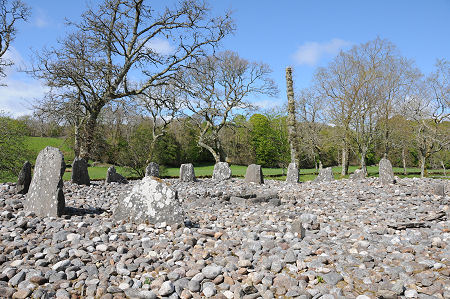 Temple Wood Stone Circle |
|
|
|
Visitor InformationView Location on Map |
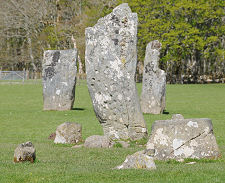 Nether Largie Standing Stones |
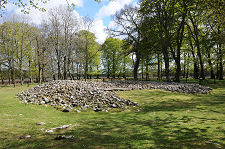 Ri Cruin Cairn |
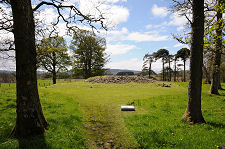 Dunchraigaig Cairn |
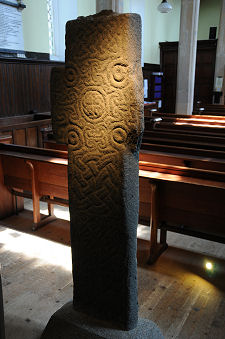 Cross in Kilmartin Church |