 Balvaird Castle from the South-East |
Balvaird Castle is perched on a hilltop overlooking the A912 as it makes its way over the eastern arm of the Ochil Hills, about a mile south of junction with the better known road leading through Glen Farg. Its location falls short of the sheer rocky impregnability of a Stirling Castle, but as a statement of dominance and control it still takes some beating.
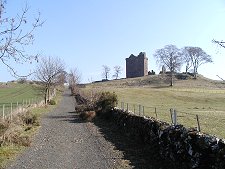
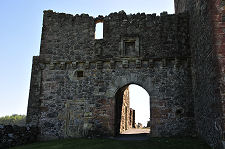
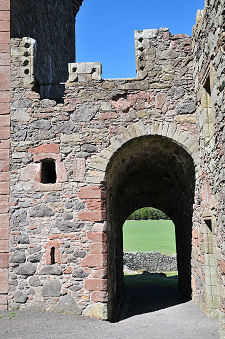
There is a visitors' car park next to the main road below the castle, though if it's locked (and it has been whenever we've visited) there is space to leave your car without causing an obstruction near the car park entrance. From there you make your way up the gravel track that curves round to the arched entrance of the castle itself. En route you increasingly appreciate just how wild and lonely a spot this is.
Balvaird Castle was built in 1500 by Sir Andrew Murray, a member of the Murray family of Tullibardine. He had acquired the land as part of the dowry that came with his wife, Margaret Barclay. It was probably placed on the site of an earlier Barclay family castle. (Continues below image...)
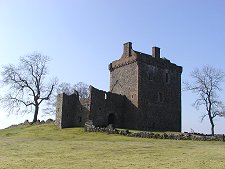
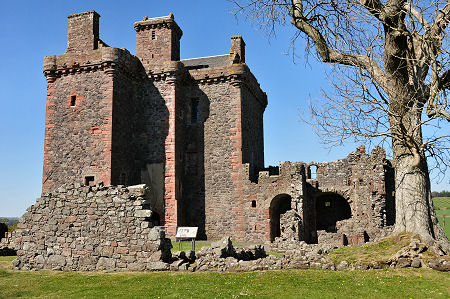
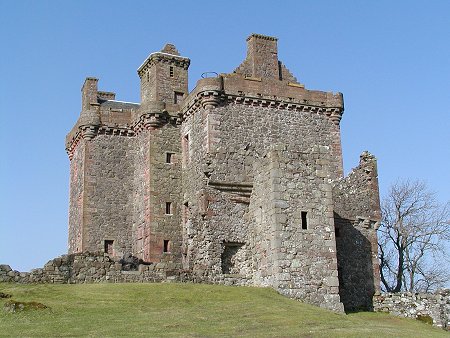 The Castle from the East in Morning Light |
The castle was built, altered, developed and improved over many years. A gatehouse range was built in 1567, and the castle also incorporated various walled gardens and an orchard. The family continued to reside at Balvaird until they inherited the titles of Lord Scone and Viscount Stormont in 1658 and moved to the rather grander estate at Scone that came with the titles.
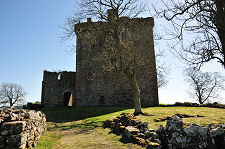
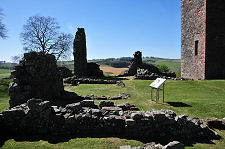
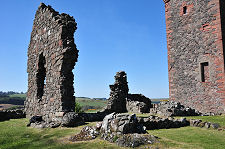
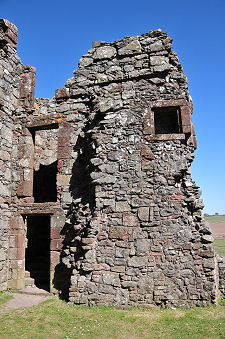
Today the castle comprises a very large tower house, only open to the public occasionally, and the ruins of a number of the courtyard buildings that supported the operation of the castle during the residence of the Murrays. It is possible to walk in a circuit through the fields below the top of the hill, and appreciate the castle and its location from all angles. Visitors calling when the tower house is not open can freely explore the ruins of the courtyard.
As is usual with tower houses of this type, the ground floor holds the castle services such as the kitchen, and it also has a pit prison within the thickness of the wall. The rest of the accommodation is built in an interesting stepped plan that has the larger rooms in the main block interleaved with the smaller rooms in the wing, and the main staircase between them. At a later date the accommodation on the first floor was extended out over the gatehouse, giving more space for the main living area.
At roof level there is a walkway around the main block, with a higher lookout tower at the head of the main staircase. From here there are extensive views over the surrounding countryside, and again you can wonder at the remoteness and beauty of the location.
Balvaird Castle isn't overrun by visitors, even on a busy day. Catch it when it's open and you can appreciate the tower house to the full, as well as the rest of the castle and its surroundings. But at other times, although you can only tour the exterior, you have every chance of having this remote and beautiful castle all to yourself. And that really is something to be treasured.
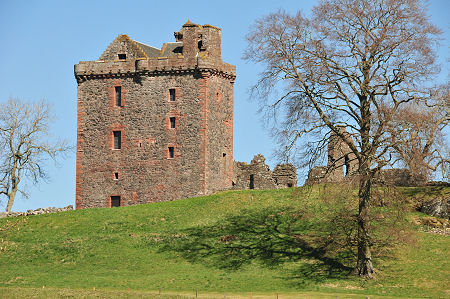 The Castle from the Approach Track |
|
|
|
Visitor InformationView Location on MapGrid Ref: NO 169 115 www.historicenvironment.scot HES: Castle Web Page The exterior can be viewed all year. What3Words Location: ///orders.consults.skillet |
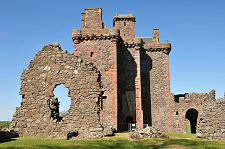 Balvaird Castle from the South Balvaird Castle from the South |
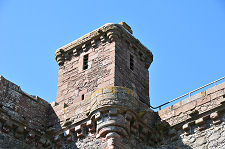 Lookout Tower Lookout Tower |
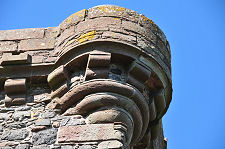 Turret Turret |
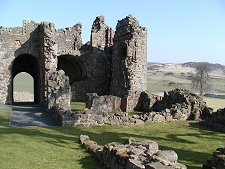 The East Range The East Range |
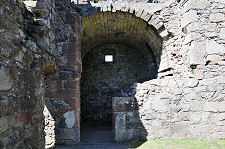 Vaulted Room in East Range Vaulted Room in East Range |
 View of the East Range |