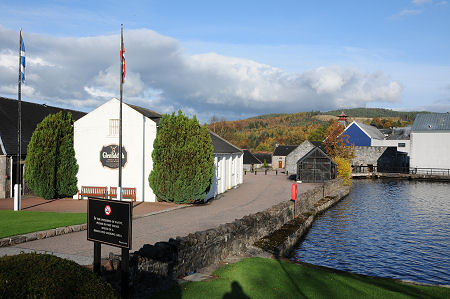
 Glenfiddich Distillery |
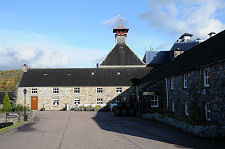
Glenfiddich Distillery stands just to the north of Dufftown, on the western side of the valley of the River Fiddich. From the visitor car park you cross the road and approach the attractively laid out distillery, passing bonded warehouses and one of the still houses en route to the entrance to the visitor centre.
Glenfiddich has a number of claims to fame. Perhaps most importantly, it was Glenfiddich which, in 1963, decided to market a single malt whisky to a world outside Scotland that until then had thought that Scotch whisky meant blended whisky. The existence of the wholly new market that has grown so dramatically since owes much to Glenfiddich; and it is fitting that theirs is the biggest selling single malt worldwide.
Glenfiddich is also one of the most popular distilleries with visitors. In part this is because its name is so well known, but in large measure it is because the visitor facilities are so good. A lot of thought has been given to ensuring everyone gets the best possible experience, and this particularly shows in facilities such as the cafe, which offers outstanding food at very reasonable prices. The Glenfiddich shop is also exceptionally good, and is especially well stocked with the products of the distillery and its close neighbour and sister distillery, Balvenie.
Combine this with a friendly welcome, well trained tour guides and free standard tours, and it is easy to see why Glenfiddich exerts such an attraction. Those wanting a closer look can book a much more in-depth "Connoisseur's Tour". The standard tour ends up in the beautifully set out Malt Barn in which participants can sip their complimentary dram or, for drivers, their orange juice while looking forward to opening their free miniature later.
Glenfiddich had its origins in the autumn of 1886, when William Grant purchased land here on which to build his new distillery. On Christmas Day 1887 the first spirit was produced from the second-hand stills Grant had purchased for £120 from Elizabeth Cummings, owner of Cardow Distillery. The name Glenfiddich came from the Gaelic valley of the deer and the first whisky produced was marketed, as it is today, under the brand of a stag's head.
The distillery is extremely unusual in remaining in the hands of the same family, operating as William Grant & Sons Ltd., throughout its life. It is still owned, together with neighbouring Balvenie, Kininvie and Convalmore Distilleries, by the Grant family. The 1900s was a era of huge change in the distilling industry, with large number of distilleries coming under the ownership of just a few huge companies who controlled much of the market.
Glenfiddich's ground breaking move into single malt whisky in 1963 owed as much to the need to avoid depending on those same giant companies to buy its product to put in their blends as it did on its farsightedness about the future direction of the market for Scotch whisky. Once Glenfiddich had proved there were an ever increasing number of buyers for single malt Scotch outside (and inside) Scotland, other distilleries started to follow their example, and the rest is history. It's been suggested that much of the success of the brand has been down to the very distinctive bottles, with a triangular cross section, initially introduced for blended whiskies produced by Grants in 1957 to make them stand out from the crowd. We suspect that more than a little of the success has also been down to the quality of what has gone into those bottles.
Over the years the success of Glenfiddich has led to the dramatic expansion of the distillery, and it now has a capacity of 10,000,000 litres of spirit per year. Expansion of an essentially craft process is no easy task if consistency is to be maintained. You can't simply invest in bigger stills when the character of the finished product depends so critically on the stills you started with.
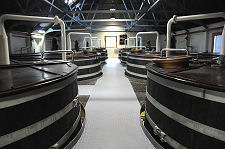
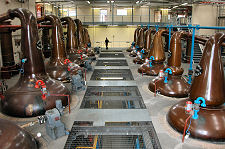
The result at Glenfiddich is two large still houses, full of a grand total of 29 stills that are replicas of those installed in 1887. This is especially noticeable with the spirit stills, which come in pairs with different shaped necks, just like the original mismatched pair purchased (presumably because they were all he could get) by William Grant. The output of each pair of spirit stills is mixed to give the final product.
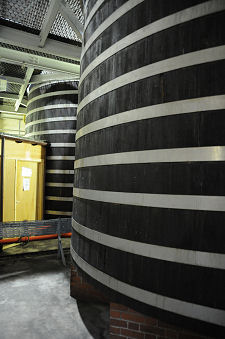
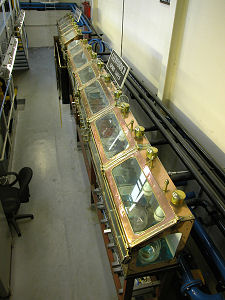
The still houses are served by no fewer that 24 Douglas fir washbacks in which the original brew ferments. Meanwhile, the two vast mash tuns sharing part of one of the still houses, and a third found elsewhere in the distillery, show that this part of the process can be scaled up to larger containers without changing the end result. You can find out more about Making Malt Whisky from our series of feature pages showing the stages in the process.
The size and layout of the distillery, and number of elements involved in each stage, means that understanding the basic processes can be harder to follow than in a much smaller operation. But this is offset by the sense of awe that comes from the sheer scale of the still house visited on the tour.
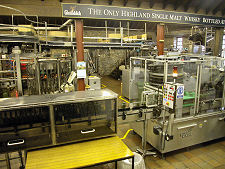
Glenfiddich is also home to a very rare on-site bottling line. This is sadly no longer part of the tour, but is significant in terms of the unexpected contribution it makes to the end product. A key ingredient of malt whisky is the water, which in Glenfiddich's case comes from the nearby Robbie Dhu spring. The same water is added to the spirit emerging from the spirit stills (at about 70% alcohol) to reduce it to "cask strength" of 63.5% when it is placed in casks. Because bottling takes place at Glenfiddich, Robbie Dhu spring water is again used to dilute the whisky to 40% alcohol when it emerges after many years in casks to be bottled. It is much more usual in the industry for the dilution and bottling to take place far away from the distillery, using distilled water for dilution.
Independent bottlings of whisky are common across the industry. It is interesting to note that almost all bottlings of Glenfiddich (and neighbouring Balvenie) have been carried out by William Grant & Sons. Whisky supplied by the cask from either distillery has always had a tiny amount of the other's whisky added, which legally turns them into vatted malts and prevents anyone else describing independent bottlings as either Balvenie or Glenfiddich.
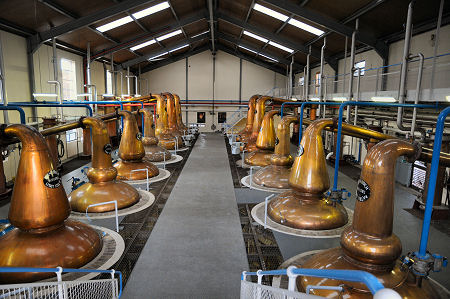 Still House Visited on the Distillery Tour |
|
|
|
Visitor Informationwww.glenfiddich.comView Location on Map Dufftown, AB55 4DH. Grid Ref: NJ 345 410 What3Words Location: ///fidget.luck.bulky |
 Glenfiddich Shop Glenfiddich Shop |
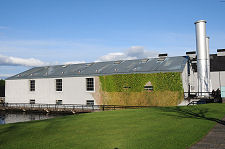 Still House Still House |
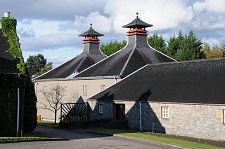 Old Maltings Old Maltings |
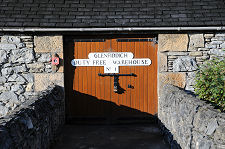 Duty Free
Warehouse No.1 Duty Free
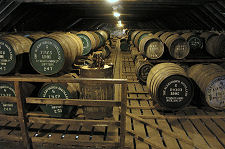
Warehouse No.1 |
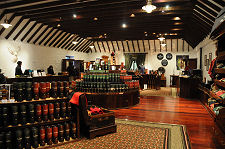 Inside the Shop Inside the Shop |
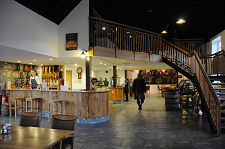 Cafe and Restaurant |
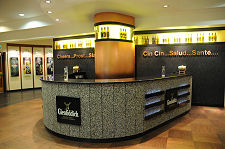 Tasting Room |
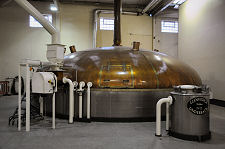 The Mash Tun |
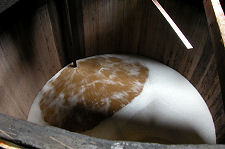
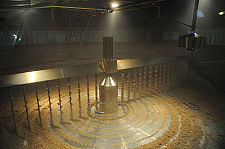 Inside the Mash Tun Inside the Mash Tun |