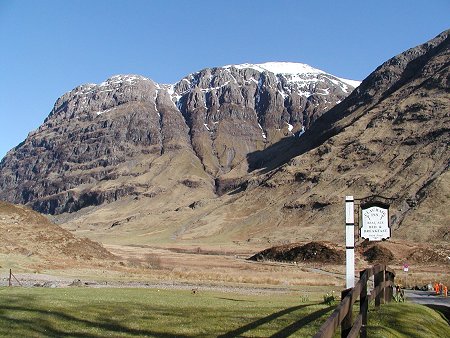
 Glen Coe Seen from the Clachaig Inn |
Glen Coe & Loch Leven covers an area of the Highlands that extends as far south as the boundary with Argyll & Bute and whose focal points are the valley of Glen Coe and the settlements around Loch Leven, just to its north. For accommodation in the area see the links in the "See and Stay" menu above. See the map below for an outline of the area and links to surrounding areas.
The glen is a popular centre for hillwalkers and climbers. Its southern side comprises a number of ridges and peaks, tending to run at right angles to the glen. The highlight must be the huge rocky pyramid of Buachaille Etive Mor, towering over Rannoch Moor as you approach from central Scotland. The north side of the glen offers far fewer Munros, just two: but they are at either end of the ragged and rocky Aonach Eagach ridge, which hems in and looms over the road and is reckoned to be the most difficult in mainland Scotland.
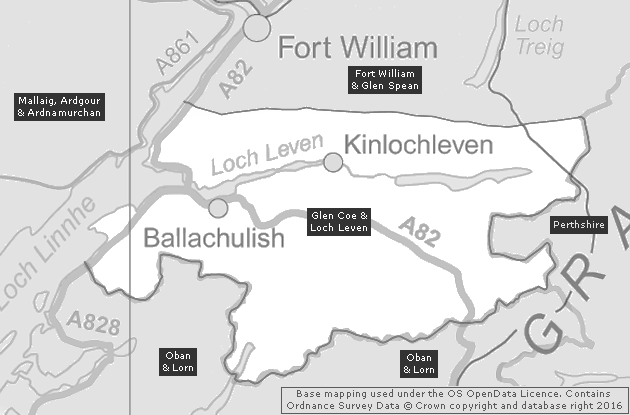 Glen Coe & Loch Leven, Showing Main Settlements & Connecting Areas |
The National Trust for Scotland owns and manages much of the glen, and there is a Visitor Centre towards its lower, western, end. Displays describe the geology of the landscape but also tell another, darker, story of Glen Coe. To find out more about the glen and the story of the massacre that took place here early on the morning of 13 February 1692, visit the Feature Page for Glen Coe. You can also visit our Historical Timeline for the wider background.
To the east of Glen Coe is Rannoch Moor, a vast area of peat and lochans. It is best viewed from the chairlift at the Glencoe Ski Centre which also offers a nice all year round cafe. A side road from the junction at the top of Glen Coe leads visitors down beautiful Glen Etive,
Glencoe is the village lying at the western end of Glen Coe, whose spectacular scenery is overshadowed only by its brooding atmosphere and bloody history. Within the village is the excellent Glencoe and North Lorn Folk Museum, while nearby is St Mary's Church.
At the end of Loch Leven and about seven miles east of Glencoe is Kinlochleven, an essential stopping off point on the West Highland Way. The Visitor Centre there tells the story of the British Aluminium Company in the area, while The Ice Factor provides both the World's largest indoor ice climbing facility and the UK's largest articulated climbing wall.
A mile to the west of Glencoe is the main settlement of Ballachulish. This is home to a range of visitor services and an excellent visitor centre. Ballachulish used to be a major centre for the production of roofing slates but production ceased in 1966. It is nonetheless still possible to visit the Ballachulish Slate Quarries and enjoy a choice of walks revealing the history of the site.
Another two miles west, passing St John's Church en route, brings you to the Ballachulish Bridge, which replaced a ferry in 1975 and now links together North and South Ballachulish. Nearby, in North Ballachulish, is the excellent Loch Leven Hotel. In the area there are a number of sites associated with the Appin Murder which have been linked together to form the Last Clansman Trail.
North of Ballachulish Bridge, the road sweeps round the coast through the strung out settlement of Onich and then heads north up Loch Linnhe towards Fort William. As it turns the first corner you pass St Bride's Church on your right, which is well worth a visit. Beyond Onich you reach the Corran Ferry, on your left, the route to a large chunk of Western Scotland and one route (via the Lochaline Ferry) to Mull.
Driving Tours: Much of the area is traversed by our Oban & Glencoe Driving Tour. The Corran Ferry features on our Fort William & Ardnamurchan Driving Tour.
|
|
|

|
|
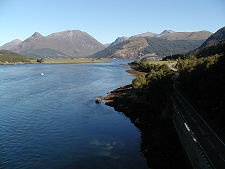 View from the Ballachulish Bridge |
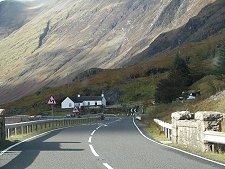 Travelling Down Glencoe |
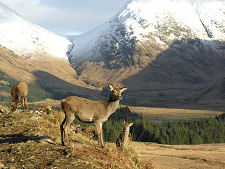 Deer in Glen Etive |
