 |
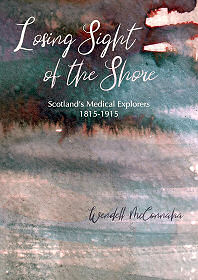
"Losing Sight of the Shore: Scotland's Medical Explorers 1815–1915" by Wendell McConnaha is a fascinating book that takes a fresh look at an aspect of Scottish, and British, history, that is all too easily overlooked. It is, in essence, the author's exploration of the reasons behind and consequences of two linked realisations he came to while researching another book. As he says in his introduction: "In the period from 1815 to 1915 Scotland's population was about one-fifth that of the population of England. Despite the difference in population of the two countries, over one-half of the British explorers I could identify from that time were Scottish." He goes on to say: "I found that in addition to the number of explorers inordinately favouring the Scots, many of these explorers were... physicians and surgeons who had received their training at Scottish universities."
The result is a superbly-researched and accessibly-written book that starts by looking at the historical background, at the events that shaped Scottish history and identity, at the culture of the Scottish Enlightenment, at the development of medical training in Scotland, and at the military background to the growth of the British Empire. The author then considers in detail at the lives and exploits of five men: Joseph Banks, Archibald Menzies, Sir John Kirk, John Rae, Sir Charles Wyville Thomson and William Spiers Bruce. This is a book we'd highly recommend to anyone who wants to further their understanding of Scotland's place in the world.
You get a good sense of the range of the content from the publisher's description of the book: "For one hundred years Scottish medical explorers were at the forefront of exploration within the British Empire, as exemplified by these five individuals. This dominant role was facilitated by the convergence of four events: the unification of Scotland and England, the Scottish Enlightenment, Scotland’s unique method of preparing doctors, and the need for a new type of explorer. These events provided the men of Scotland with a trajectory that was quite different from their English counterparts."
"Throughout the century of exploration, Britain concentrated on expanding its already extensive global empire, and leading this movement were the men of Scotland. Over half of the British explorers from this era were Scottish and often doctors who had received their training at Scottish universities. Those graduating from the University of Edinburgh outnumbered those from other Scottish universities by a ratio of almost 9 to 1. Why were there so many Scottish doctors exploring a dangerous and unknown world and why were these medical explorers uniquely more qualified to lead this effort? A key factor was that the British Imperial Century required a new type of explorer. Prior exploration had focused on finding new lands, establishing trade routes, and creating colonies."
"Although trade and profit were still significant considerations, new focuses like economic botany and voyages exclusively for the sake of science took precedence. Losing Sight of the Shore shines a light on this most productive and adventurous era while providing detail and context about the people and the times in which they lived. Although Losing Sight of the Shore profiles five medical explorers in detail, this is not a biography but a history which aims to understand and explain the ideology and philosophy of a group of Scottish-trained physicians and surgeons; and how their interaction within the political, cultural, intellectual, and social context of the time helped define the British Imperial Century."
InformationPaperback: 192 pagesWhittles Publishing portopress.com 6 December 2024 Language: English ISBN-10: 1849955948 ISBN-13: 978-1849955942 Size: 15.88 x 1.27 x 22.86 cm Buy from Amazon (paid link) Visit Bookshop Main Page |