 |
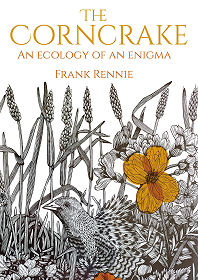
"The Corncrake: An Ecology of an Enigma" by Frank Rennie is a remarkable book. I should put my cards on the table straight away. I'm not an ornithologist, and while I like and appreciate birds, I know little about them. But the Corncrake is rather special. I recall some years ago being entranced by listening to the repetitive "crex crex" call of one of the birds hiding out of sight in grassland on the island of Vatersay, near the southern end of the Western Isles. Much more recently, and fleetingly, I heard one near the western shore of Loch Ewe in Wester Ross. Again the calling bird was keeping well out of sight. Beyond that, about the only thing I knew about the Corncrake before reading this book was that they are very much fewer and further between than they used to be.
When the opportunity to review Frank Rennie's book was offered, I jumped at the chance of learning more about one of Scotland's most elusive and reclusive residents. "The Corncrake: An Ecology of an Enigma" does an amazing job of peeling back the lid on what is known about the Corncrake: and on the surprising amount that is still to be learned, assuming they are around long enough for us to find out. Though obviously drawing on a huge amount of research, the book is well written in an accessible style that ensures it will be enjoyed by anyone who wants to know more about this bird: a bird which, I now know, is not just Scottish, but is found across large parts of northern Europe and central Asia, as well as being a migrating visitor to south-eastern Africa.
The book is nicely produced and has a section of colour images as well as a number of charts and maps in the text. The thirteen chapters look at different aspects of the Corncrake. They cover an introduction to the bird; the family background; the Corncrake in history and culture; the bird in the landscape; its physical characteristics; population and distribution; breeding biology; migration; calls and signalling; food and feeding; predators, parasites and problems; habitat management and conservation; and further research. The result feels like a comprehensive assessment of the current state of man's (imperfect) understanding of the Corncrake. This is an important book that deserves to be widely read and it's impossible to read it without some concern that as we increasingly damage the planet we live on, the Corncrake's future is in peril.
Some of the research unearthed by the author is amusing and entertaining as well as enlightening. In discussing the bird's highly distinctive calls he relates that it has long been known that "a fairly good imitation of the rasping call of the Corncrake could be imitated by rubbing two dry bones together, if one of the pieces has a serrated edge. In England and Scotland, well seasoned horse ribs were apparently preferred, while in Ireland, Otter bones were believed to be the correct density to imitate the original sound. A similar effect can be produced by drawing a hard plastic comb across the edge of a credit card at the rate of roughly two scrapes per second."
InformationPaperback: 208 pagesWhittles Publishing portopress.com 29 April 2022 Language: English ISBN-10: 1849955026 ISBN-13: 978-1849955027 Buy from Amazon (paid link) Visit Bookshop Main Page |