 |
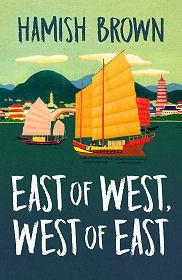
We approached "East of West, West of East" by Hamish Brown with a slight sense of déjà vu. In 2017 we reviewed his "not an autobiography", "Walking the Song", and as we said at the time, "The book opens with Hamish and his family evading the Japanese invasion of Singapore in 1942." We went on, however, to say: "It's not long before Scottish hills begin to feature, and those who think they know Hamish Brown begin to feel at home."
"East of West, West of East" by Hamish Brown is a very much fuller account of his early life, and of his family's terrifying exploits, in Japan, Malaya and Singapore in the period immediately before and during the early years of the Second World War. As you read the book, it is very easy to understand why the author and his publishers felt that a story which was necessarily pared down to fit within a more broadly-based (non) autobiography was worth telling in a much fuller and more detailed way. The result is a fascinating account of a period in the author's life that it is impossible to read about without a huge dose of hindsight. As the book opens, we read that Hamish's younger brother was born in Yokohama in December 1940, at which point his older brother and his grandmother were travelling out to join the family from Scotland "for safety". This was, of course, a year before Japan's attack on Pearl Habor, but the reader cannot help share the author's sense, reflected in his inverted commas, that with hindsight Japan was the very last place that should have been thought of as "safe".
The book has drawn heavily on family journal entries, letters home and personal recollections. What emerges is a book that can be appreciated and enjoyed as one family's efforts to cope with the world-changing events around them: but we suspect it also represents a genuinely important contribution to the understanding of the impact of those world-changing events on the lives of the people caught up in them. We know as we read the book that the eventual ending is going to be a happy one for the key participants. It is easy to forget that this was knowledge not shared by those participants at the time they were writing their letters or journal entries: and that many who were caught up in the same dreadful events did not survive the war. In recent times there has been considerable interest in "microhistory", which can be defined as the intensive historical investigation of a well-defined smaller unit of research in a way that asks "large questions in small places". It may not have been the author's intention to produce a work of microhistorical research, but that's certainly one of the ways in which this is such an impressive book. This is particularly true of the picture painted of life in Yokohama - and of the birth of Hamish's younger brother - by his mother's letters to his grandmother.
At a personal level, I found the author's story as it touched on Singapore to be of particular interest. As a small child I lived in Singapore for a couple of years in the early 1960s, just two decades after the events described in "East of West, West of East"; and at a time when physical reminders of the Japanese invasion and occupation could still readily be seen on the ground. But you don't need any personal connection with the subject matter to appreciate that this is an outstanding book. It succeeds in being readable and engaging as well as historically significant.
InformationPaperback: 173 pagesSandstone Press Ltd sandstonepress.com 19 July 2018 Language: English ISBN-10: 1912240254 ISBN-13: 978-1912240258 Size: 12.9 x 1 x 19.8 cm Buy from Amazon (paid link) Visit Bookshop Main Page |