 |
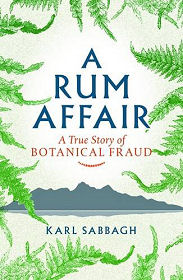
"A Rum Affair: A True Story of Botanical Fraud" by Karl Sabbagh is one of the best books we have read in quite some time. It's tempting to end this review at that point, because it is much easier to say how much we like this book than it is to say why we like it so much. A simple description of "A Rum Affair" doesn't really offer much in the way of clues. In the 1940s the eminent British botanist John Heslop Harrison promoted a controversial theory, that vegetation on the islands off the west coast of Scotland had survived the last Ice Age. His theory was controversial because it ran counter to the belief of most botanists, that the extent and the 10,000 year duration of the ice had been enough to, quite literally, wipe every plant off the face of those parts of the Earth affected, including the Hebrides.
But John Heslop Harrison said he had proof that his theory was correct, in the form of a number of species of grasses he had discovered on several Hebridean islands, and in particular on the island of Rum. These could only have been present if they were relics of a pre-Ice Age world. John Heslop Harrison was a man it would have been easy to dislike. He was forceful in his views and unpleasantly aggressive in their defence. When his character came up against some equally singular individuals in the botanical community who held opposing views the result was a schism that festered for years. Where did intellectual rigour and legitimate argument cease, and dirty tricks begin? And who was playing the tricks? Enter the story one John Raven, an amateur botanist and a young classics academic at Cambridge. Raven was a figure of the establishment, whereas Harrison had risen from lowly working class roots in the north-east of England. On the other hand Raven was the amateur, a man with no formal scientific training, whereas Harrison was a leading figure in his field, widely respected if little liked outside his immediate circle at Newcastle University. Raven was drawn into the argument by botanical opponents of Harrison's, and took it upon himself to investigate Harrison's work.
At one level "A Rum Affair" can be read as two parallel investigations, the first by Raven into Harrison and his discoveries, and the second by Karl Sabbagh in pursuit of the truth behind the discoveries and the allegations about them. It is the interplay between these two investigations that draws you in and keeps you turning the page. We're pretty sure from the outset (not least from the spoiler contained in the book's subtitle) that Harrison was a fraud, but the process of establishing how and why is a truly fascinating one. Not to say a gripping one: we are still not sure exactly why, but reading this book is like reading an extremely well written fictional thriller. Some of the similarities are obvious. Raven begins his investigations on the (at that time largely inaccessible) island of Rum with a clandestine landing from a neighbouring island. He then, to use modern parlance, goes undercover to gain entry a second time by hoodwinking Harrison about his reasons for being there. The worst that could have happened had Raven's cover been blown was his ejection from the island, but this part of the book is still genuinely exciting.
What Raven discovered was not surprising in light of the book's title and the cover blurb. The story of the way that events then unfolded, or more accurately failed to unfold, is perhaps the most important part of the book. Karl Sabbagh has done an amazing job unearthing the background to what happened, and drawing out the wider implications for science in society. This is a new edition of a book that was first published in 1999, and contains new, and important, material whose existence only came to light as a result of the publication of the first edition.
InformationPaperback: 288 pagesBirlinn Ltd birlinn.co.uk 23 June 2016 Language: English ISBN-10: 178027386X ISBN-13: 978-1780273860 Size: 12.9 x 2.3 x 19.8 cm Buy from Amazon (paid link) Visit Bookshop Main Page |