 |
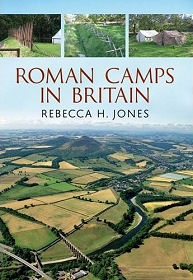
"Roman Camps in Britain" by Rebecca H. Jones is a true labour of love. It grew out of her PhD research at the University of Glasgow and the end result is a fascinating overview that goes into sufficient detail for anyone with an interest in the subject while remaining accessible to the general reader. Clarity of writing plays a large part in this, as does careful organisation. The book begins with a historical overview of the Roman conquest of Britain. Chapters then deal with topics such as "What is a Roman Camp?"; the available historical sources of information about Roman Camps; their sizes, layouts, and capacities; the story of their archaeological exploration; their re-use and survival; particular features and forms; and their distribution, chronology and context.
The author begins by noting that a great deal of research has been undertaken on Roman frontiers, and on permanent Roman fortresses and forts: but goes on to suggest that temporary Roman camps are the bridesmaids of the study of Roman military architecture. So what is a Roman camp? In chapter three we read that Roman camps are temporary fortifications constructed, usually, by troops on campaign. Some were constructed by advancing armies to protect each overnight halt and could be huge in size. Others were built to facilitate the siege of an enemy defensive position, or to house troops engaged in some major construction project, perhaps of a more permanent fort or a frontier such as the Antonine Wall. Still others, usually the smallest and found in groups, appear to be practice camps, built by troops being trained for campaign.
Temporary camps tended to be more prevalent in areas where the Empire had not secured a lasting peace or stable frontiers. This mean that many of those to be found in the UK are in Wales and, especially, in Scotland, where the progress of armies engaged on a number of different campaigns over the centuries of Roman occupation of southern Britain can be charted by the overnight camps they left behind them.
InformationPaperback: 176 pagesAmberley Publishing www.amberley-books.com 3 February 2012 Language: English ISBN-10: 1848686889 ISBN-13: 978-1848686885 Size: 24.4 x 17 x 1.4 cm Buy from Amazon (paid link) Visit Bookshop Main Page |