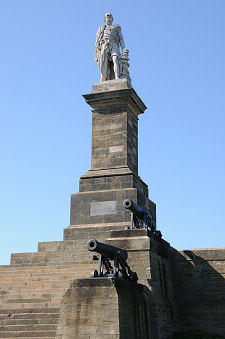
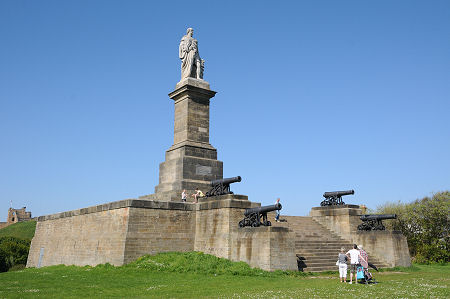
 The Collingwood Monument from the South-West |
Standing overlooking the River Tyne at Tynemouth is the imposing Collingwood Monument. Finding your way here can be a little tricky, but it is thoroughly worth the slight effort involved. The secret is to look out for a path leading diagonally upwards from the nearby car park: our own efforts to follow the shore around from the actual mouth of the River Tyne were not successful.
Vice Admiral Cuthbert Collingwood, 1st Baron Collingwood, lived from 26 September 1748 to 7 March 1810. He was the son of a Newcastle merchant. At the age of twelve, he went to sea as a volunteer on board the frigate HMS Shannon under the command of his cousin Captain (later Admiral) Richard Braithwaite.
In June 1775 he fought at the battle of Bunker Hill during the siege of Boston, and on the same day was commissioned as a lieutenant in the Royal Navy. Collingwood served alongside Nelson two years later, and in 1779 succeeded him as captain of HMS Badger.
The careers of the two men had a lot in common as both worked their way up the naval hierarchy during the 1780s and 1790s. Collingwood was promoted to vice-admiral in 1804, and at the Battle of Trafalgar on 21 October 1805 was second in command of the British fleet under Admiral Nelson. While Nelson was on board HMS Victory at the head of one half of the fleet that day, Collingwood was on board HMS Royal Sovereign, which was the first British ship to engage. After Nelson was fatally wounded, Collingwood took command of the British fleet as they defeated their French and Spanish counterparts. On 9 November 1805 Collingwood was raised to the peerage as Baron Collingwood, of Caldburne and Hethpool in the County of Northumberland.
Collingwood became Commander-in-Chief of the Mediterranean Fleet in 1805. His health subsequently declined, and Collingwood died on 7 March 1810 while en route back to England for medical leave. He was laid to rest besides his close friend Nelson in the crypt of St Paul's Cathedral. Collingwood is by far the less well known of the two, but in many eyes he was as accomplished a naval commander as Nelson, and his memory lives on in the North-East of England, not least through the presence of the enormous Collingwood Monument, built here in 1847.
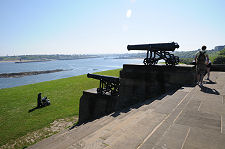
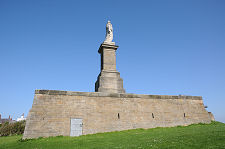
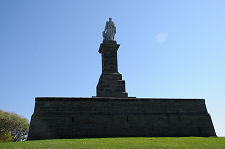
Just how enormous it is seems unclear, as none of the usual references reveal the size of the overall monument. They do however reveal that the actual statue of Collingwood which stands on top of it is 23ft tall, and scaling from photographs suggests that the square tower it stands on is, with the steps at it foot, some 60ft in height, while the massive box-like plinth at the foot of the monument adds a further 20ft. This gives an overall height for the monument of just over 100ft, and it is made all the more imposing by a location on ground rising from the River Tyne below. The steps up the front of the monument are flanked by four cannons from HMS Royal Sovereign.
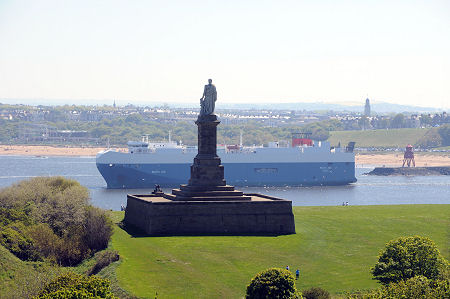 The Collingwood Monument and the River Tyne |
|
|
|
Visitor InformationView Location on MapGrid Ref: NZ 372 691 What3Words Location: ///large.skirt.opera |
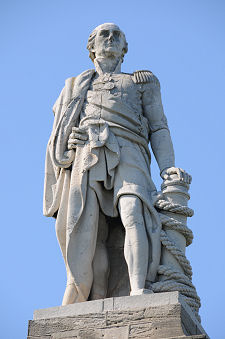 Statue of Collingwood |
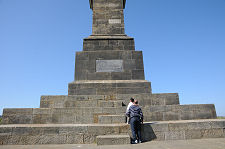 Part of the Plinth |