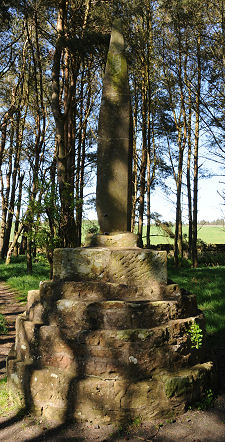
 Percy's Cross with the Site of the Battle Beyond |
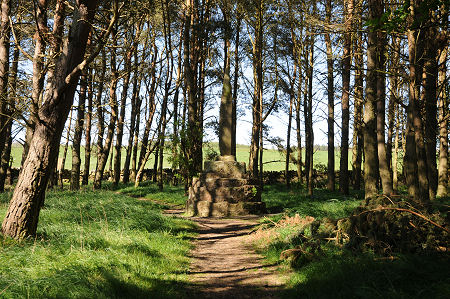
As the main A68 from the Scottish Border to Newcastle sweeps down from Carter Bar into Redesdale the first significant settlement you encounter is Otterburn. Half a mile before you reach it, a narrow stand of trees extends north from the road. You can turn off into the trees, and from a parking area a footpath leads to Percy's Cross, which commemorates the nearby Battle of Otterburn, fought on the night of 5 August 1388.
England and Scotland had been intermittently at war for the better part of a century by this time, and would remain so for several more centuries. After a short period of relative peace, the Scots under the Earl of Carrick, supported by a French army, had invaded northern England in June 1385. They were beaten back, and in retaliation an English army destroyed Melrose and Dryburgh Abbeys, and then Edinburgh itself, before deciding they'd proved their point and withdrawing.
In 1388 England was preoccupied by the perceived threat of invasion from France, and the Scots took advantage by attacking north-east and north-west England. The attack on the north-east was led by James Douglas, 2nd Earl of Douglas, and he lay waste to the countryside as far south as Durham before turning north in the face of the superior English forces being assembled against him.
The reason for what happened next is the subject of some debate. The romantic version of the story is that in an encounter outside the walls of Newcastle the Scots captured the pennant of Sir Henry "Hotspur" Percy, the eldest son of Henry Percy, 1st Earl of Northumberland. Chivalry demanded that Percy make every effort to recapture his flag: and it also required Douglas to allow him the chance to do so. As a result Douglas and his forces stopped at Otterburn to await the arrival of Percy. A more likely interpretation is that Percy, as a March Warden charged with keeping the fragile peace along the border, had a duty to chase down the Scots, and made every effort to do so as quickly as possible.
Either way, 5 August 1388 found the Scots army, perhaps up to 6,000 strong (accounts differ widely), camping just west of Otterburn after an unsuccessful attempt to capture the tower there. Early in the evening they were surprised by the arrival of Sir Henry "Hotspur" Percy, living up to his reputation for impetuosity at the head of an army of perhaps 8,000 that had force marched from Newcastle.
The battle commenced as night fell on open land to the north-west of Otterburn: the same place (though with a rather different landscape) that you can view from the wall beyond Percy's Cross today. Despite strong moonlight, the decision by Percy to attack at night prevented the English using their best weapon, their longbows: and when the exhausted English engaged in hand to hand combat with the fresh and rested Scots, they came off second best. It is said that some 1,800 English were killed during the battle, compared perhaps only 200 Scots. Sir Henry "Hotspur" Percy was captured, along with his brother, while on the Scottish side, James Douglas, 2nd Earl of Douglas was among those killed.
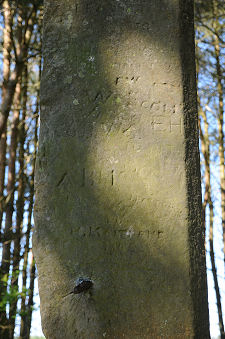
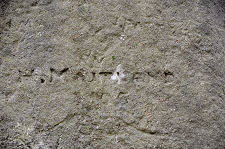
The battle site was long marked with a monument called the Battle Stone. In 1777 the base of this was moved a short distance to its current location after it was disturbed during the building of a turnpike road. which later became the A68. The socket in the top was filled, so it is said, with the lintel from the kitchen fire at Otterburn Tower, and the result is Percy's Cross. There may be other reminders of the battle too: one night in November 1960 witnesses reported seeing a ghostly army on the march on the nearby road, and this remains a very spooky place at night or in poor visibility.
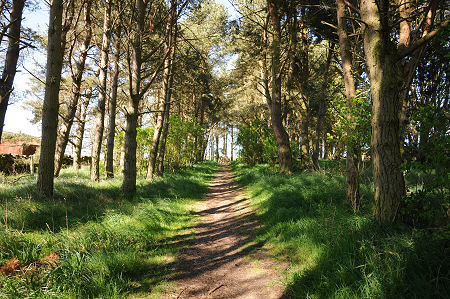 The Path to the Cross from the Parking Area |
|
|
|
Visitor InformationView Location on MapGrid Ref: NY 879 939 What3Words Location: ///lock.corrupted.goal |
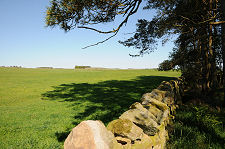 Looking North-East Over Battlefield |
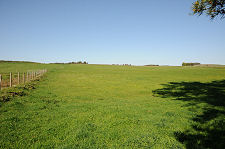 Looking North Over Battlefield |
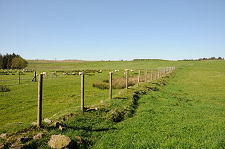 Looking North-West Over Battlefield |
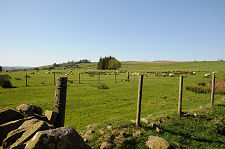 Looking West Over Battlefield |
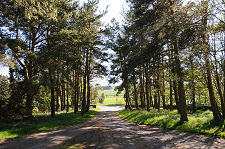 Approach to Parking Area |