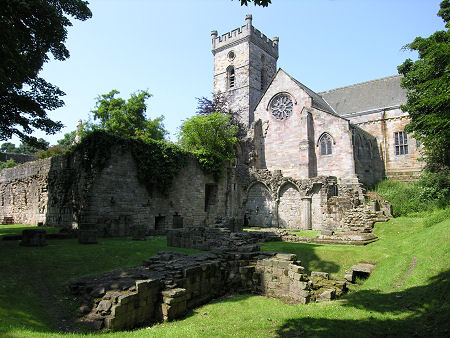
 Culross Abbey |
Elizabeth Melville, Lady Culross, lived from about 1578 to about 1640. She was the first Scottish woman writer to have her work appear in print. The wider picture in Scotland at the time is set out in our Historical Timeline.
Elizabeth Melville was the daughter of Sir James Melville of Halhill, a statesman who served in the courts of Mary, Queen of Scots and King James VI and who wrote Memoirs of His Own Life. She was born near Collessie in Fife and was educated to a high standard at home. In about 1597 she married John Colville, the eldest son of Alexander, Commendator of Culross Abbey (in effect, the laird who had managed to gain the lands of the abbey at the time of the Reformation in 1560). John inherited his father's title (but not much of his money) in 1597. The family lived near Culross, with Elizabeth acquiring the honorary title of Lady Culross. The couple had at least seven known children.
In 1603, Elizabeth published Ane Godlie Dreame in Scots, with an English translation the following year. She thus became the first (known) Scottish woman writer to have her work appear in print. The poem is described by its Calvinist author as an account of a dream she had when in deep spiritual anguish. It uses some of the imagery and style of medieval dream vision poetry in a form and language acceptable to Protestants and it proved highly popular at the time, being reprinted many times over the following two centuries. Many believe it was the inspiration for Bunyan's Pilgrim's Progress. The poem describes and discussed the spiritual experience of a woman active in the the presbyterian party within the Scottish Reformed Kirk of the 1600s, and has some distinctly Scottish landscape settings.
Although best known for Ane Godlie Dreame, Elizabeth wrote many other poems and songs. A large manuscript containing 29 of her poems only came to light in 2002. Elizabeth died at Culross in about 1640. Her youngest son, Samuel Colville, followed in her footsteps as a writer, while the eldest, Alexander, became a church minister and Hebrew scholar, first in France and then at St Andrews University.