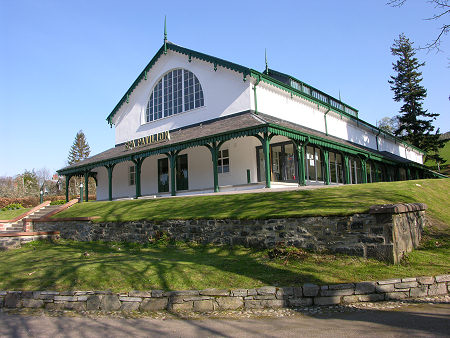
 Strathpeffer Spa Pavilion |
Strathpeffer stands in the upper reaches of Strath Peffer, some four miles west of Dingwall. As late as the early 1800s, the settlement did not exist and the land on which it stands was divided between four farms. In the mid 1700s a sulphurous spring was discovered here and in 1777 the Reverend Colin McKenzie, who was both the parish priest and the manager of the estate on which the spring stood, arranged for it to be fenced off to prevent its pollution by cattle.
Not long afterwards a London doctor wrote a paper for the Royal Society on the health giving powers of the water to be found here, and in the early 1800s a Dr Morrison from Aberdeenshire declared his arthritis to have been cured by the waters. In 1819 largely thanks to Dr Morrison's efforts to spread the word about the miracle cures on offer here, Strathpeffer's spa water became available on a commercial basis when the first pump room was built.
Over the following decades, Strathpeffer grew to become the most un-Scottish of Scottish towns, largely thanks to the efforts of Anne, Duchess of Sutherland and Countess of Cromartie. She wanted Strathpeffer to resemble the spas she had seen in Europe and much of the look and feel of today's town is due to her efforts from the 1840s to the 1870s. The result has variously been compared to Harrogate in Yorkshire and to a Bavarian mountain resort. All such comparisons fail to do justice to somewhere quite unique. Strathpeffer has to be experienced on its own terms to be really appreciated.
Despite the developments of the middle decades of the 1800s, fully developing the spa's potential was impeded by Strathpeffer's remoteness and the simple difficulty of getting here. The daily horse drawn coach to Inverness took three hours each way and cost the considerable sum of 6 shillings. This all changed with the arrival of the railway in 1885. The station was built at the lower end the town at the end of a 2½ mile length of line laid from a junction on the main line to Kyle of Lochalsh near Dingwall. This spurred on development and Strathpeffer reached its height as a spa in the years immediately before World War One.
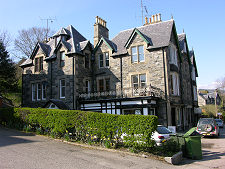
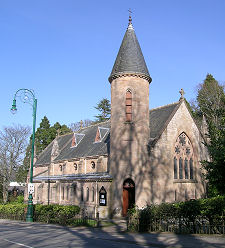
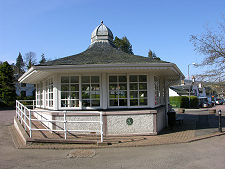
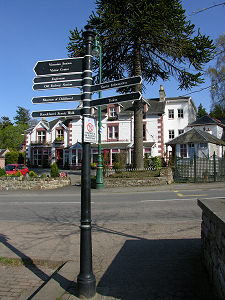
In many ways the main reason to come to Strathpeffer is to see and enjoy the town itself. The buildings, though in a wide variety of styles, all exude a no-expense-spared solidity that says much about their largely Victorian origins and about the wealth of the town at the time that much of it was built. Large and not so large hotels are interspersed with fine houses and villas and some attractive churches, including St Anne's Episcopal Church. The original Spa Pavilion has been magnificently restored after a period of disuse. It now serves as a multi-purpose venue for a variety of events, including concerts, dances, dramatic productions, conferences and exhibitions, as well as weddings and other functions.
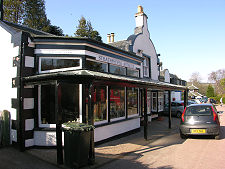
In recent times it has only intermittently been possible to sample the waters, first in the pagoda-like room in the car park on the opposite side of the main road which is now a cafe, and later in the pump room a little uphill from the pavilion itself.
Trains no longer bring visitors to Strathpeffer, but the Victorian railway station still stands, having been restored to new uses. The Old Railway Station is now the home of the excellent Highland Museum of Childhood, as well as to a coffee shop and a number of interesting shops. A little uphill on the opposite side of the main road from the Old Railway Station is an intriguing Pictish carved stone, the Eagle Stone.
The town is a popular base for walkers; there is plenty in the vicinity to suit all abilities. From the west end of the village a forest track leads to the hill of Cnoc Mor; a diversion en-route takes in Knock Farril a Pictish hill fort, worth the trip for the views alone. A more modern construction, dating from the early 1990s, is the Touchstone Maze. This is a maze formed from 81 stones in concentric circles, using many different types of rock found in Scotland.
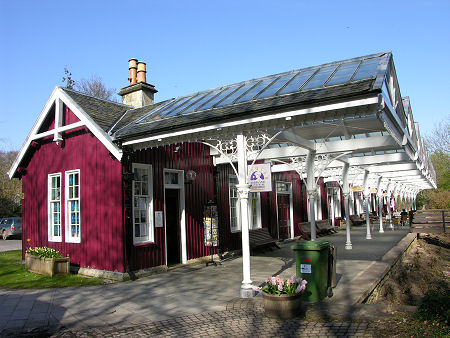 The Old Station |
|
|
|
Visitor InformationView Location on MapWhat3Words Location: ///clef.pitching.locator |
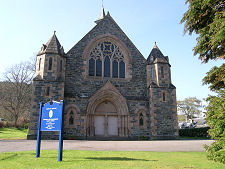 The Parish Church |
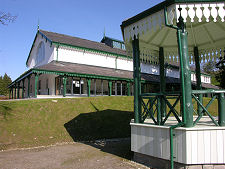 Another View of the Pavilion |
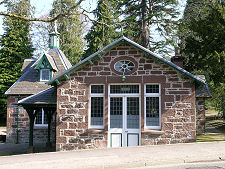 Pump Room and Tourist Information |
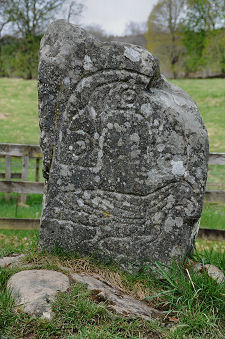 The Eagle Stone |