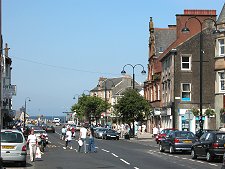
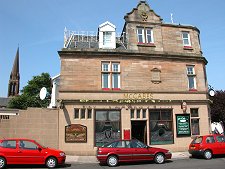
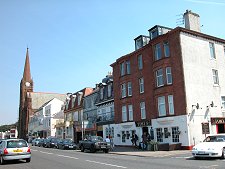
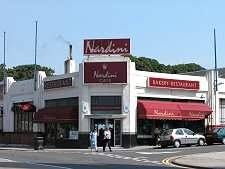
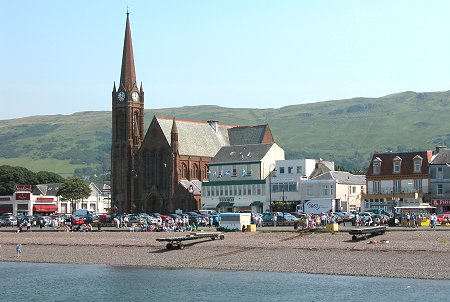
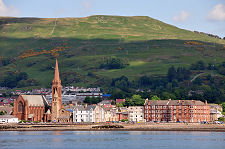
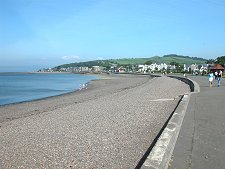
 Largs Seafront from the Pier |
The town of Largs lies on the North Ayrshire coast of the Firth of Clyde, sheltering behind the northern tip of the island of Great Cumbrae. It is closely bounded to the east by the high ground that gives the town its name: Learg is Scottish Gaelic for "Hillside".
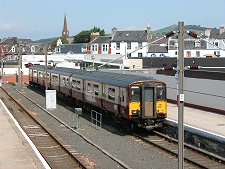
Largs has evolved primarily as a genteel retirement resort. In part this is due to the obvious attractions of the town's location. In part it is also because Largs is one of the least accessible of the Firth of Clyde settlements. The town has had a railway station since the Glasgow and South-Western Railway arrived in 1885. However, as the line to Glasgow first heads south to Ardrossan, Largs has traditionally been less popular as a dormitory for commuters to Glasgow than other towns along this coast.
This has change to some extent since the railway was electrified in 1987, but Largs is interesting in varying far less than many other resorts between seasons, and between week and weekend, because of its large permanent population.
Largs has strong links with the sea. Today these are reflected in the sailing boats and marina, and in the ferry service that provides Great Cumbrae's link with the outside world.
From June to August each year Largs pier is a regular calling point for the Waverley, the world's last sea-going paddle steamer, as it carries trippers around and across the Firth of Clyde. This is a reminder of an earlier age when Largs was on the route of many Clyde steamer services. The town was also home to a ferry to the Isle of Bute until Wemyss Bay's much better rail links to Glasgow displaced it.
As you stroll along Largs' pleasant pebbles beaches, it is worth remembering that 740 years ago an encounter took place here that changed the course of history and helped shape the Scotland we know today.
Until the late 1200s much of the western seaboard of Scotland and the Western Isles had been under the distant control of Norway, despite the efforts of Alexander II and later of Alexander III to regain influence and power for the Scottish Crown.
Alexander III's challenges to the rule of the Norse culminated with a large fleet of longships under King Håkon IV (see our Historical Timeline) from Norway and the Isle of Man sailing into the Firth of Clyde and making their headquarters at the northern end of the island of Great Cumbrae, opposite Largs.
The Norwegians subdued the Isle of Bute and Kintyre before dragging up to 60 ships overland from Arrochar to Tarbet and into Loch Lomond, allowing them to pillage the surrounding countryside.
Alexander III moved the modest Scottish army he had gathered in Ayr north up the coast towards Largs. Most of September 1263 was spent in negotiations between Alexander and Håkon: the latter growing ever more impatient, the former playing for time and hoping for the onset of bad weather. This duly arrived in the form of a fierce storm on the night of 30 September 1263 which sank some of Håkon's ships and drove a number of others ashore at Largs.
What has since become know as "The Battle of Largs" was really no more than a series of largely inconclusive skirmishes. But although his forces probably still outnumbered the Scots, in the face of a demoralised and mutinous fleet, Håkon IV had little choice but to sail for home.
He never reached it, dying in the Bishop's Palace in Kirkwall, Orkney, en route. With him died the Norse claim over the Western Isles. The full story can be read in The Norwegian Account of Haco's Expedition Against Scotland; 1263.
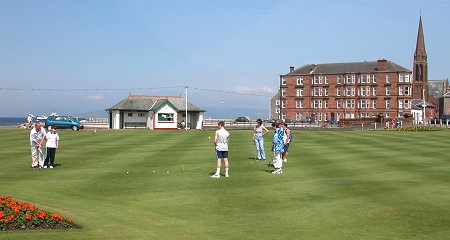 Putting Greens |
|
|
|
Visitor InformationView Location on MapWhat3Words Location: ///breeze.sooner.scout |
 View from the Ferry |
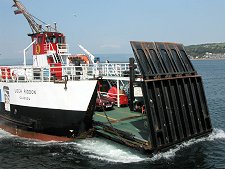 Ferry "MV Loch Riddon" |
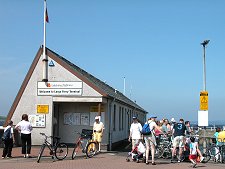 Largs Ferry Terminal |
 Largs Bay |
 Railway Station |