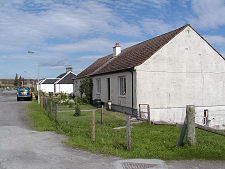
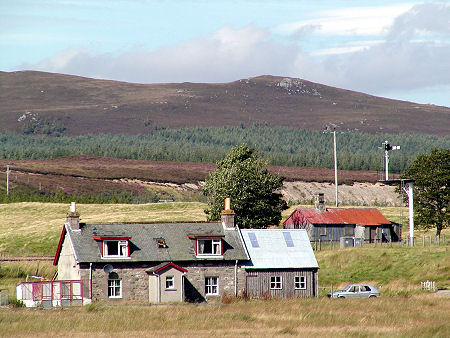
 Cottages and Railway Line, Dalwhinnie |
Dalwhinnie sits at the head of Loch Ericht where it meets Glen Truim, at a maximum height of 1,180ft. This makes it a little higher than the Highlands' officially highest village at Tomintoul, 40 mountainous miles to the north-east. It remains, however, some way short of Scotland's highest village, Wanlockhead, at 467m or 1,531ft.
While Dalwhinnie's altitude may not always gain the recognition it deserves, Dalwhinnie Distillery is by a few feet only the second highest distillery in Scotland. This beautifully kept white-painted complex of buildings stand out for miles as you approach Dalwhinnie on the A9, which bypassed the village in the late 1970s. Scotland's highest distillery is the little known Braeval Distillery, in the Braes of Glenlivet a few miles beyond Tomintoul.
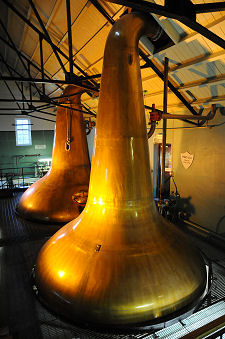
Although Dalwhinnie's malting has been done elsewhere since 1968, the distillery has thankfully kept its two distinctive pagodas. Its origins date back to 1897, when it was briefly known, misleadingly, as the Strathspey Distillery. Dalwhinnie Distillery's location and visibility mean that it is very popular with visitors, and it is a good "first distillery" as the guides are knowledgable and enthusiastic and the production elements are well laid out and relatively easy to understand.
Dalwhinnie came into being around an inn that from the early 1700s served the needs of Highland cattle drovers en route to the market at Crieff. On a single day in August 1723 over 1200 head of cattle passed through Dalwhinnie, in eight different droves.
In 1729 Dalwhinnie was the point at which military road construction teams working south from Inverness via Ruthven Barracks and north from Dunkeld met, completing the predecessor to today's A9. Another road was built to the north-west crossing the high level Corrieyairack pass from Laggan to Fort Augustus, a route abandoned as a road in the 1820s.
The Inverness and Perth Junction Railway arrived in Dalwhinnie in 1863, and the village still has its railway station today. This provides one of several points of focus for this rather sparse and dispersed settlement. The others are the distillery at the north end of the village, the Inn at Loch Ericht at the south end of the village, and the houses around the junction between the old A9 and the side road to the railway station. In recent years Dalwhinnie has become the focus of a widespread network of tunnels and dams providing hydro-electric power for the Scottish grid, and forestry has also become in important activity in the area.
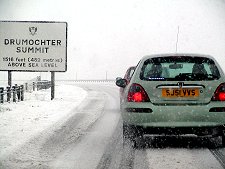
South of Dalwhinnie the A9 climbs towards the summit of the Pass of Drumochter, whose 1516ft or 432m summit marks the high point of the road's passage through the Cairngorms. This height allows relatively easy access to the mountains around Gael Charn.
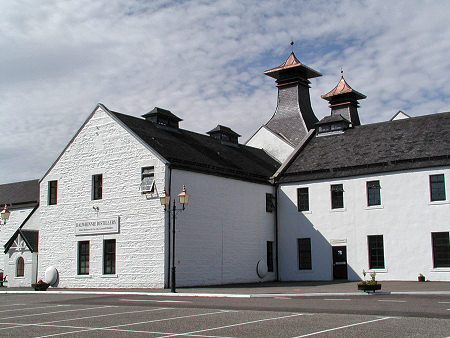 Dalwhinnie Distillery |
|
|
|
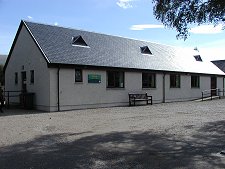
Visitor InformationView Location on MapWhat3Words Location: ///tapes.radiated.bloom |
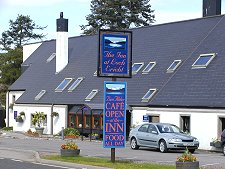 The Inn at Loch Ericht |
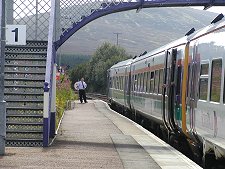 Dalwhinnie Station |
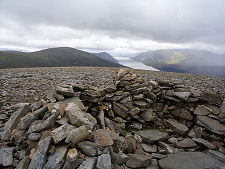 The Summit of Gael Charn |