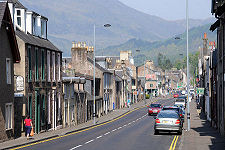
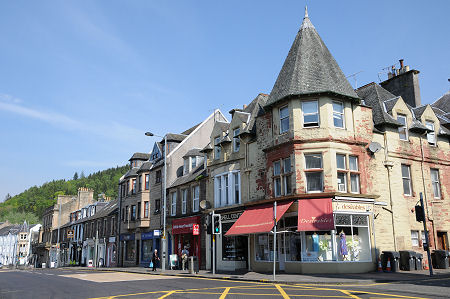
 Callander's Main Street from the South-East |
Callander lies 14 miles north-west of Stirling on the A84, and forms a gateway to the Highlands. It can also an entry point to the Loch Lomond and the Trossachs National Park, which became the first of Scotland's two National Parks when it was established in 2002. Here the fertile plains come to an end, and the mountains begin. Here you leave behind you the link to the motorway network of the central belt, and look ahead to Ben Ledi, which dominates views along the road as you approach Callander from the south-east.
For many visitors the "real" Scotland starts here. For the Highlands you continue on along the road that will take you north-west to Crianlarich, Fort William and beyond. For the Trossachs you head south-west instead, to Aberfoyle and Loch Katrine. Callander's attraction to visitors goes back a long way. The Romans named this place Bochastle when they built a fort beside the River Teith here in the first century AD. Today this episode in Callander's history is marked primarily though the name of the Roman Camp Hotel, near the eastern end of the town.
The next notable development was also military. This was the road built through the area by Major Caulfeild in 1743 as part of the network intended to allow pacification of the Highlands in the aftermath of the 1715 Jacobite uprising. In practice this network was mostly of use in assisting the 1745 uprising.
By 1790 visitors to Callander were proving important enough to the economy for the local minister, James Robertson, to produce one of Scotland's first tourist guides: A Pamphlet Descriptive of the Neighbourhood of Callander. The real growth came twenty years later, however, with the publication of The Lady of the Lake by Sir Walter Scott. This placed the Trossachs very firmly on the tourist trail, and Callander became the focal point for the ever increasing numbers of visitors coming to see the area for themselves. Two notable visitors in 1803 were the poet William Wordsworth and his sister Dorothy. The latter subsequently published her impressions in her Recollections of a Tour Made in Scotland: 1803.
The Trossachs popularised by Scott are often painted as a "Scotland in miniature", an area of lower mountains and lakes that are interestingly reminiscent of the English Lake District, which was also seeing a tourist boom in the early 1800s. Whether the Trossachs would have achieved their fame without the influence of Sir Walter Scott is debatable. For some they are just the foothills of the real Highlands: for others they remain the most attractive part of Scotland.
The Dunblane, Doune and Callander Railway arrived in the town in 1858 and confirmed Callander's status as a tourist destination. It then took a further 22 years for the Callander & Oban Railway to finally reach Oban. This all stopped with Beeching's railway cuts of 1965, and since then the nearest railway stations have been at Stirling or Crianlarich. There are still traces of the railway line visible on the northern side of Callander.
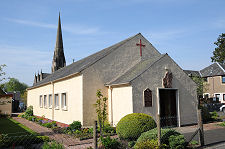
Today's Callander is a bustling, sometimes crowded town which stretches out along the line of the A84. At its centre is Ancaster Square. The north side of this is dominated by the former St Kessog's Church, now home to the Tourist Information Centre. The south side has at its centre a war memorial in the form of a traditional mercat cross. The Rob Roy connection is celebrated by the 79 mile Rob Roy Way which passes through Callander on its route from Drymen to Pitlochry.
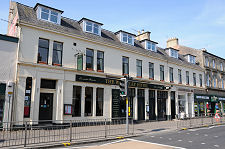
The main street is home to a wide selection of shops, and there is plenty of accommodation on offer in the town as well, ranging from small hotels, guest houses and B&Bs to the imposing Dreadnought Hotel towards the west end of the town.
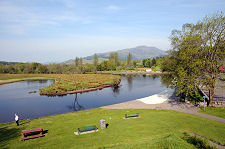
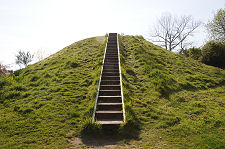
Even when it's busy, it is possible to get away from Callander's main street to see a quieter aspect of the town. Parallel to the main street and a little to the south is the lovely River Teith. This can be prone to flooding after heavy rain, but catch it in a more benign mood and it does present an idyllic scene. Anyone walking along the riverside cannot help but be struck by a large, obviously artificial, grassy mound close by. This is "Tom na Chisaig", which roughly means "Kessog's Hill" and was widely believed to have been the spot where St Kessog, one of the early Celtic saints, preached to his congregation. It seems more likely that it was constructed in the 1100s as a motte, which would have been topped off with a wooden castle.
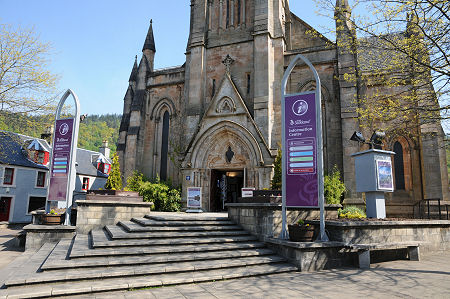 Ancaster Square and the Tourist Information Centre |
|
|
|
Visitor InformationView Location on MapWhat3Words Location: ///returns.loose.scrolled |
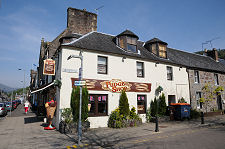 The Old Fudge Shop |
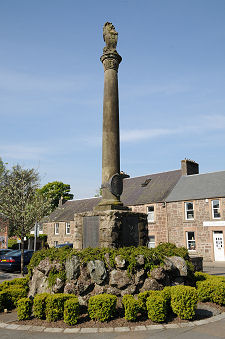 The War Memorial |
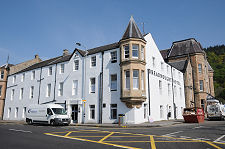 Dreadnought Hotel |
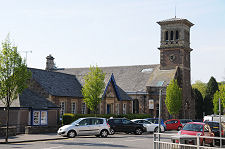 Callander Kirk |
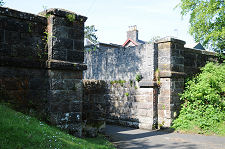 Traces of the Old Railway Line |