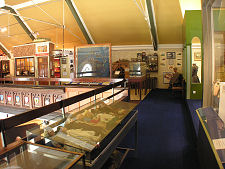
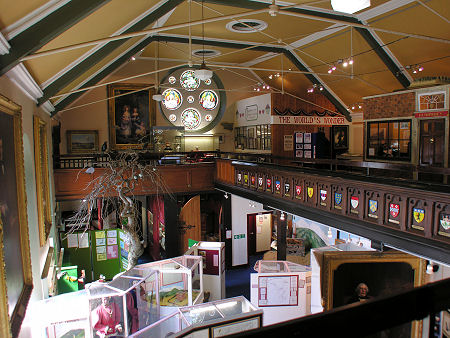
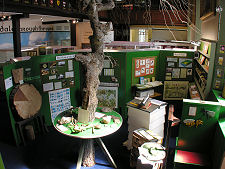
 View of the Heritage Centre from the Upper Floor |
The Moat Park Heritage Centre has closed and been replaced by the superb Biggar & Upper Clydesdale Museum, which opened in Biggar in the summer of 2015. This page remains as it was when the heritage centre was open, to allow a glimpse of what was on offer here.
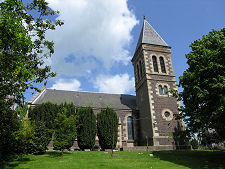
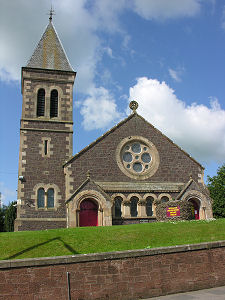
The Moat Park Heritage Centre occupies the converted Moat Park Church and stands looking across the B7016 to Carnwath at Biggar Kirk. There is no parking at the heritage centre itself: it is best to park in the centre of Biggar and make the short walk from there.
The Moat Park Church was built in 1865. It was opened as a museum by HRH The Princess Royal on 29 June 1988 after extensive work that included the insertion of an upper floor wrapping around three sides of the building.
Biggar is unique in Scotland in having a remarkable collection of museums dealing with different aspects of its history or with notable individuals who were born here. They are all looked after by the Biggar Museums Trust, whose aim is to collect, store, preserve and record the historical heritage of the area. Some are quite specific in their coverage and aims. The Moat Park Heritage Centre, on the other hand, provides a home to a series of collections and exhibits about many aspects of life in Upper Clydesdale and Tweeddale. This makes it the widest ranging of Biggar's museums. It is also the largest, and provides a home for the Biggar Museums Trust itself.
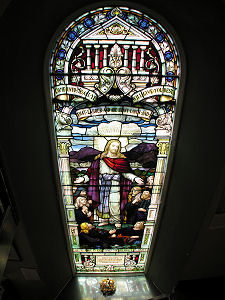
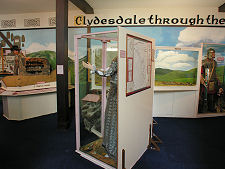
The Moat Park Heritage Centre is not the only disused Scottish church to have been converted into a museum, but its conversion is certainly one of the most effective. The internal space has been used superbly to give a range of interesting display areas that make full use of the height of the church, while at the same time the conversion has made best use of the light streaming in through the stained glass windows that line the south wall.
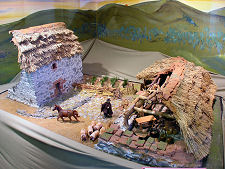
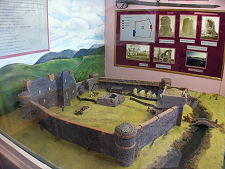
A range of different display techniques are used in the heritage centre, but two are especially successful in bringing the past to life. Particularly impressive are a series of detailed scale cutaway models of notable buildings in the area shown in their historical context. These include farmsteads and cottages, a bastle (fortified) house, a Roman fort, and even a lovely model of Boghall Castle in its prime and a far cry from the ruins that now stand in a field just to the south of Biggar.
The model of the Roman fort is accompanied by an example of the second approach very successfully adopted in the heritage centre: a life size figure of a Roman legionnaire. In this case the legionnaire is carrying a gruesome trophy of a recent battle in the shape of a severed enemy head: but even without it he is an imposing figure.
Elsewhere you come across a life size Iron Age family comprising a father, mother and child, all dressed in home-produced woollen clothes and accompanied by many of their household objects. Other residents include Mary Fleming, a native of Biggar who became a lady in waiting to Mary, Queen of Scots; King James II; and Lord Fleming of Boghall Castle, all as life size figures which add considerable presence to the displays.
Many topics are presented in a more traditional way, by collections of artefacts relating to a particular theme displayed together. An area at the rear of the centre is home to an especially effective collection that looks at the history of churches in the Biggar area, complete with plates and chalices, a font and a communion table, and even the Lamington Kirk bell, made in 1545, but replaced in 1843 after becoming cracked.
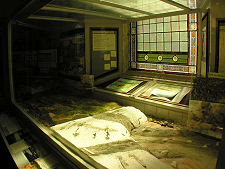
Other exhibitions cover the geology of Upper Clydesdale, the natural world and the environment, transport in the area, costume, toys, play... and far, far more.
The Moat Park Heritage Centre really should be highly recommended, both as an excellent introduction to the history of the area, and as an excellent example of how vibrant and interesting a local museum can become.
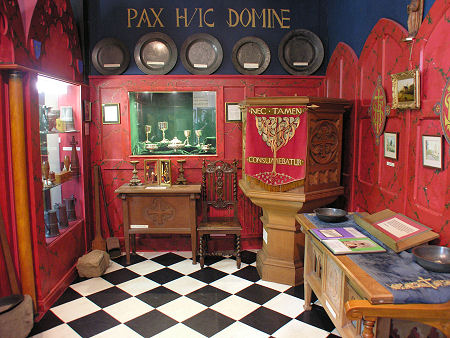 The Story of the Church in and Around Biggar |
|
|
|
Visitor InformationView Location on MapClosed: see note in text. |
 Heritage Centre from the B7016 |
 The Natural World |
 Model of Boghall Castle |
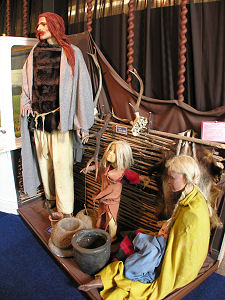 Iron Age Family |