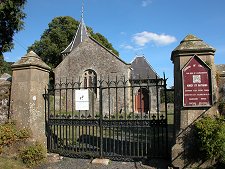
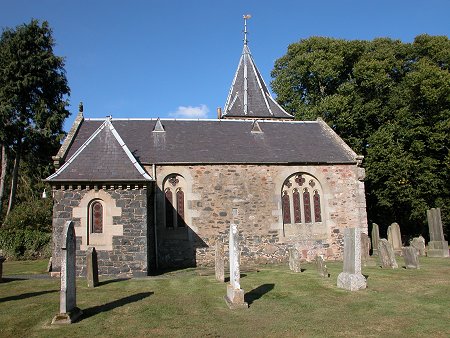
 Kirk of Lammermuir, Abbey St Bathans |
The village of Abbey St Bathans is a tiny, fragmented settlement on very minor roads some five miles north of Duns. It lies in the steep-sided valley of the Whiteadder Water just downstream of its confluence with the the Monynut Water.
This helps explain the surprisingly heavily engineered footbridge that carries the Southern Upland Way over the Whiteadder Water and the six foot high depth marker on the nearby ford through the river. Both are testament to the sudden flooding that has characterised this stretch of river over the centuries.
The Southern Upland Way long distance path passes through Abbey St Bathan en route from Portpatrick on the Irish Sea to Cockburnspath, almost on the North Sea. Those planning to walk the Way should be aware that the Youth Hostel shown in Abbey St Bathans on a number of maps, and in some of the information about the Southern Upland Way, is no longer open.
The village has two main claims to fame. The first is its appearance at the top of any alphabetical list of Scottish settlements. The second, rather oddly given its name, is that it has never been home to an abbey. That is slightly misleading because in about 1200 a small Cistercian priory of twelve nuns was founded here by Ada, Countess of Dunbar.
The site was chosen because it was believed to have been that previously used for a tiny chapel established by St Bathan, a follower of St Columba, in the late 500s. The priory comprised a small church and an accompanying collection of domestic buildings. It was largely destroyed by English troops in 1543 and was probably no longer a going concern when the Reformation came along in 1560.
After the Reformation the remains of the domestic buildings were reused in field walls and village buildings, while the priory church was repaired to become the parish church of Abbey St Bathans and Strafuntin.
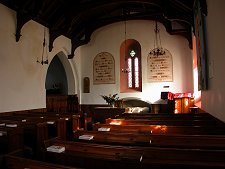
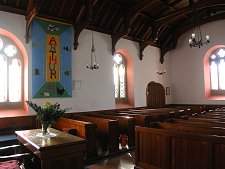
The church is a real treasure, full of wonderful light from the simple stained glass windows. At the east end the early history of the building is recalled by the alcove containing the recumbent effigy of one of the prioresses.
|
|
|
Visitor InformationView Location on MapGrid Ref: NT 759 623 What3Words Location: ///youths.heap.rigs |
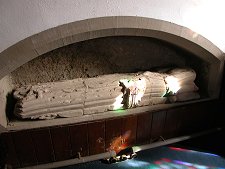 Effigy of a Prioress |
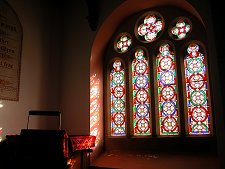 Stained Glass Window |